
Barber Certificate in Pittsburgh: 1-2 Year In-Person Guide
Earn a Barbering/Barber Certificate in 1 to 2 years in person at Barber School of Pittsburgh and step into a licensed, hands-on trade with a clear path to earning.

By Lucas Scott
Barbering is a hands-on trade where steady hands, sharp tools, and reliable technique matter more than almost any other credential. Yet before you can pick up clippers behind a chair, most states require formal training at a licensed barber school. In Pittsburgh, one of the clearest pathways is a Barbering/Barber Certificate, 1 year to less than 2 years In-person at Barber School of Pittsburgh. This credential blends classroom instruction with supervised practice on real clients, and it is designed to move you from beginner to license-ready in a defined window of time. If you are weighing a career change, comparing trade programs, or simply trying to understand what barber training actually involves, this guide walks through the structure, costs, licensing steps, and career outcomes you should expect.
What the Barber Certificate Program Covers
A barber certificate is a focused, non-degree credential. Unlike a two-year associate degree that includes general education courses, certificate programs concentrate almost entirely on the skills and knowledge you need to pass a state licensing exam and work in a shop. At Barber School of Pittsburgh, the program runs between one year and less than two years, which is typical for a comprehensive barbering curriculum that includes both theory hours and practical clinic time.
Coursework generally falls into three broad areas: technical cutting and shaving skills, sanitation and safety, and business fundamentals. Students spend significant time on haircutting techniques (fades, tapers, scissor work, and clipper-over-comb), facial hair design, straight-razor shaving, and hair and scalp care. Alongside these hands-on skills, you will study anatomy, skin conditions, disinfecting procedures, and the Pennsylvania barbering regulations that govern the trade.
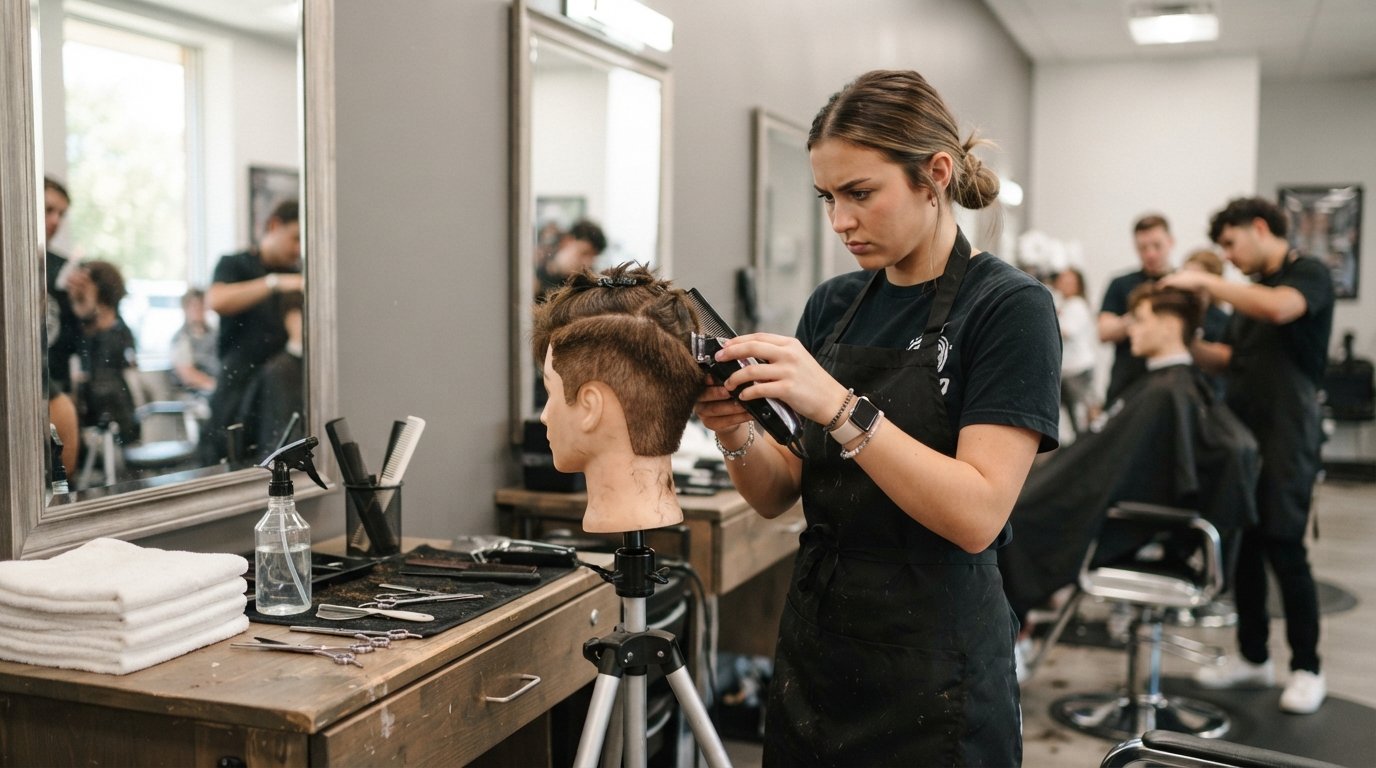
Because the program is delivered in person, you practice on mannequins first and then on real clients in a supervised clinic floor. That live-client experience is a major advantage: employers and state examiners both care about whether you can manage a real head of hair, not just answer multiple-choice questions. The certificate is not a degree, but it is the credential most states, including Pennsylvania, expect before you sit for the licensing exam.
Why Choose an In-Person Program in Pittsburgh
Barbering is one of the few fields where online learning cannot replace physical practice. You need to feel the tension of a clipper, learn how to hold a razor at the correct angle, and build the muscle memory that only comes from repetition under supervision. An in-person program at a Pittsburgh barber school gives you that environment, along with access to instructors who have worked in shops and can correct your technique in real time.
Pittsburgh also offers practical advantages for students. The city has a dense network of neighborhood barbershops, from established chains to independent shops in areas like Lawrenceville, the South Side, and Shadyside. That density creates opportunities for part-time work, apprenticeships, and client-building while you are still in school. Many students begin cutting hair for friends and family during training, then transition into a chair soon after licensure.
Finally, a local program keeps your commute manageable and your professional network close. Barbering is a referral-driven business, and the instructors, classmates, and shop owners you meet in Pittsburgh can become your first employers or your first referral sources. For adult learners balancing a job or family, a predictable in-person schedule with a defined completion window often works better than a self-paced online course that leaves you without hands-on feedback.
Admission Requirements and What to Expect
Admission to a barber certificate program is generally straightforward, but it still requires preparation. Most schools ask for a high school diploma or equivalent, proof of age, and a completed application. Some programs require a brief interview or a tour of the facility before enrollment. Because the program is in person, you should also confirm the schedule: full-time students may attend class five days a week, while part-time options spread the hours over evenings or weekends.
Here is a typical checklist of what applicants should prepare before enrolling:
- High school diploma or GED, with transcripts available on request
- Government-issued photo ID and proof of age (usually 16 or 18 and older)
- Completed application and, in some cases, a short admissions interview
- Deposit or registration fee, plus a plan for tuition and kit costs
- Confirmed schedule that fits work or family commitments
Beyond paperwork, think about the practical costs of training. Tuition for a barber certificate varies by school, and you will also need a student kit that includes clippers, shears, razors, capes, and sanitation supplies. Some schools bundle the kit into tuition; others charge separately. Ask about payment plans, and compare the total cost against the earning potential of a licensed barber in your area. If cost is a concern, it also helps to understand how financial aid and tuition planning work for trade programs, which is where a resource like CollegeAndTuition's college cost guides can help you compare options and avoid surprise expenses.
Licensing in Pennsylvania: The Step After Graduation
Completing the certificate is only part of the path. To work legally as a barber in Pennsylvania, you must obtain a license from the state board that regulates barbering. The process typically involves submitting proof of completed training hours, passing a written exam, and passing a practical exam that tests your cutting and shaving skills. Requirements can change, so always confirm current rules with the Pennsylvania State Board of Barber Examiners before you enroll.
The sequence usually looks like this:
- Complete the required training hours at a licensed barber school.
- Submit your application and school certification to the state board.
- Schedule and pass the written licensing exam.
- Schedule and pass the practical licensing exam.
- Receive your license and begin working or renting a chair.
Each step has its own timeline and fees. The written exam covers sanitation, anatomy, and regulations, while the practical exam asks you to demonstrate cuts and shaves under timed conditions. Your school should prepare you for both, but it is wise to ask about pass rates and exam prep support before you enroll. A program that treats licensing as an afterthought is a red flag; a strong program builds exam readiness into the final months of training.
Costs, Financial Planning, and Return on Investment
Barber training is generally less expensive than a bachelor's degree, but it is not free. Tuition, kit costs, exam fees, and lost income during training all add up. The good news is that barbering has a relatively short path to earning: once licensed, you can start working and building a clientele without waiting four years for a degree. That shorter runway is part of the appeal for career changers.
To plan realistically, break the cost into categories: tuition, tools and kit, licensing and exam fees, transportation, and living expenses during training. Then compare those costs against entry-level barber pay in Pittsburgh, which varies by shop type, commission structure, and whether you rent a chair or work as an employee. Many new barbers start on commission and gradually build a book of clients before moving to booth rent, which can increase take-home pay but also shifts overhead costs to you.
It is also worth comparing the barber certificate with adjacent credentials. If you are interested in the business side of personal care or want a management track, a program like a healthcare management certificate online guide shows how certificate pathways work in other fields, though barbering remains a hands-on trade that requires in-person training. For most students, the barber certificate is the most direct route to a chair, and the return on investment depends on how quickly you build a clientele after licensure.
Career Paths and Earning Potential After Certification
A barber certificate opens more doors than many people expect. The most common path is working in a barbershop, but licensed barbers also move into education, product sales, shop ownership, and even film and theater work. Each path has different income potential and different demands on your time.
Common career options include:
- Barber in a traditional or modern shop, often on commission or booth rent
- Mobile or house-call barber serving clients at home or events
- Barber educator or school instructor after gaining experience
- Shop owner or manager overseeing staff and operations
- Product specialist or brand educator for grooming companies
Earnings vary widely. Commission-based barbers typically earn a percentage of each service, while booth renters pay a fixed weekly or monthly fee and keep the rest. Tips can be a meaningful part of income, especially in high-traffic shops. Building a repeat clientele is the single biggest factor in long-term earnings, which is why many new barbers focus on customer service, consistency, and social media marketing in their first year.
It is also worth thinking about specialization. Fades, beard design, and straight-razor shaves each attract different clients, and some barbers build a reputation around one style. Continuing education, such as advanced cutting classes or business workshops, can help you raise prices and stand out in a crowded market.
How to Choose the Right Barber School
Not all barber programs are equal, even when they lead to the same license. When comparing schools, look beyond the brochure and ask specific questions about schedule, class size, clinic hours, instructor experience, and licensing pass rates. A program with a strong clinic floor and experienced instructors will prepare you far better than one that emphasizes classroom lectures over hands-on practice.
Practical factors matter too. Confirm the total cost, including kit and exam fees, and ask whether payment plans are available. Visit the campus if you can, and talk to current students about their experience. Ask how many hours are spent on live clients, how the school handles exam prep, and what job placement support it offers. For adult learners, also confirm that the schedule is realistic for someone balancing work or family.
Finally, check accreditation and licensing status. The school should be licensed by the state and able to document its approval to train barbering students. Accreditation matters less for barbering than for degree programs, but state approval is non-negotiable. If a school cannot clearly explain its licensing status and exam outcomes, keep looking.
Is the Barber Certificate Right for You?
The barber certificate is a strong fit for people who want a hands-on trade, prefer a shorter training timeline, and are comfortable working with the public. It suits career changers who want to start earning sooner, creative workers who enjoy precision and style, and entrepreneurs who eventually want to own a shop. It is less suitable for people who prefer remote work or who are uncomfortable with the physical demands of standing for long hours and working with sharp tools.
If you are still exploring, compare the barber path with other certificate and degree options before committing. Trade programs, associate degrees, and online certificates each have different time and cost profiles. The key is to match the credential to the career you actually want, not just the fastest option available. For Pittsburgh students, the in-person barber certificate offers a clear, local route into a licensed trade with a defined training window and a direct path to earning.
Take the next step by visiting schools, asking about schedules and costs, and confirming licensing requirements with the state board. A well-chosen program can turn a one-to-two-year commitment into a long-term career behind the chair.