
Carpentry Associate's Degree at Columbus State: 2-Year Path
A Carpentry/Carpenter Associate's degree, usually 2 years In-person at Columbus State Comm College, builds hands-on skills for a durable construction career.

By Elena Owens
Skilled carpenters are in steady demand across residential, commercial, and industrial construction, and a formal credential can shorten the path from helper to lead craftsperson. If you are weighing a trade education against a four-year degree, a Carpentry/Carpenter Associate's degree, usually 2 years In-person at Columbus State Comm College, offers a structured, hands-on route into the building trades. This guide explains what the program covers, how the in-person format builds job-ready skills, what admissions and costs typically look like, and how the credential translates into wages, advancement, and further study. It also shows how to compare this local option with online degree pathways so you can make a decision that fits your schedule, budget, and career goals.
What a Carpentry Associate's Degree Program Covers
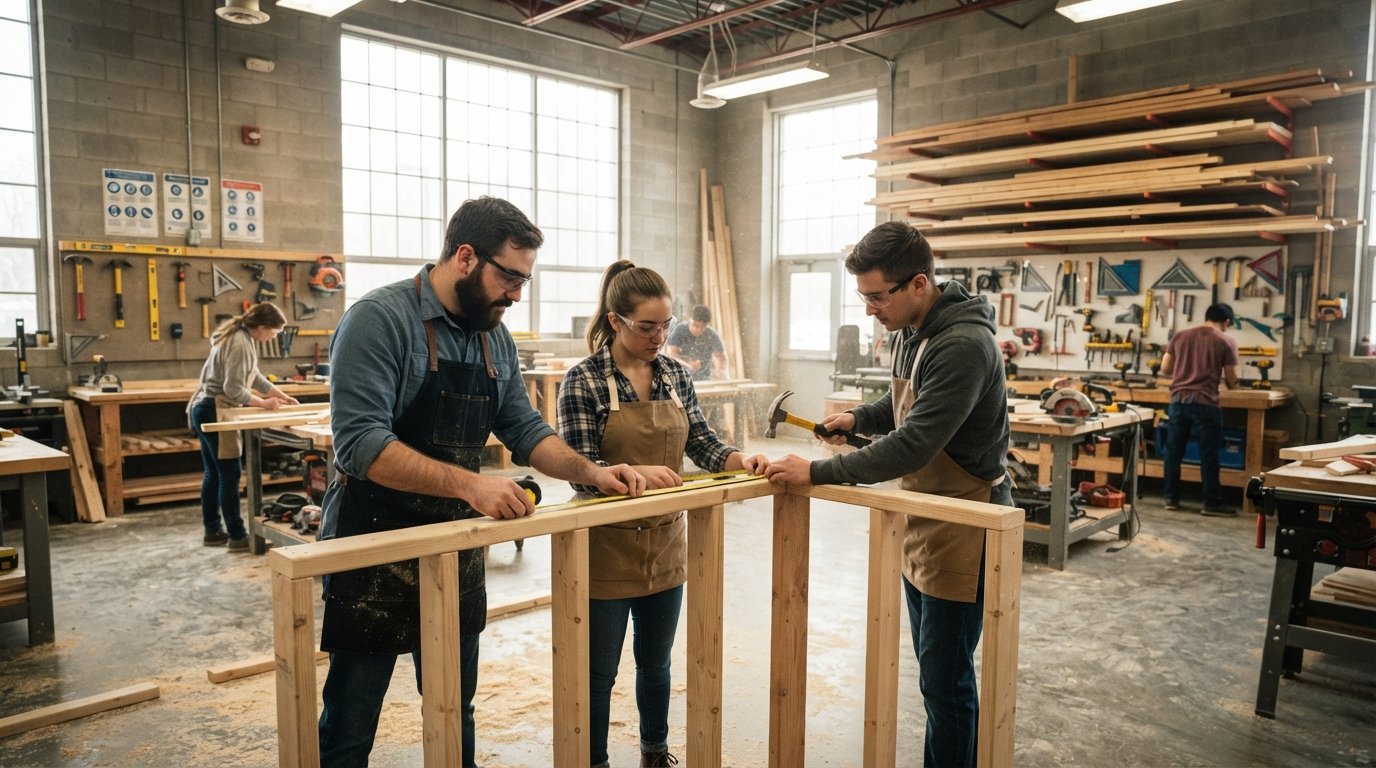
An associate's degree in carpentry is more than a series of shop classes. At a community college like Columbus State, the curriculum usually blends technical construction courses with general education requirements, producing a credential that employers recognize and that can transfer into related bachelor's programs. The technical core typically starts with safety and tool use, then advances through framing, exterior and interior finish, and project management fundamentals. Because the program is delivered in person, students spend substantial time in labs and on construction projects rather than watching demonstrations online.
Coursework generally includes blueprint reading and drafting, which teaches students to interpret residential and light commercial plans, recognize symbols and dimensions, and translate drawings into material lists. Structural framing courses cover floor, wall, and roof systems, including layout, cutting, and assembly techniques. Finish carpentry modules address cabinetry, trim, doors, and stairs, where precision matters most. Many programs also require estimating and scheduling coursework, because carpenters who can price a job and sequence a crew are the ones who move into supervisory roles. General education courses in communication, math, and workplace safety round out the degree and support transfer options.
Beyond the syllabus, the in-person format delivers something online programs struggle to replicate: supervised repetition with real materials. Students cut, fit, and correct mistakes under an instructor's eye, which builds judgment that videos cannot convey. Lab sections often simulate job-site conditions, including time pressure and coordination with other trades. That environment also creates relationships with instructors who frequently have industry connections, and those relationships can turn into internships, apprenticeships, or first jobs after graduation.
Why the In-Person Format at Columbus State Comm College Matters
Carpentry is a tactile trade, and employers consistently report that hands-on experience is the strongest signal of readiness. A Carpentry/Carpenter Associate's degree, usually 2 years In-person at Columbus State Comm College, is designed around that reality. Students work with the same tools and materials they will encounter on job sites, from framing nailers and circular saws to levels, lasers, and layout tools. Instructors can correct technique in real time, which reduces bad habits and improves safety awareness before students enter the workforce.
The in-person schedule also mirrors the rhythms of construction work. Classes often run in blocks, with early starts and long lab sessions that resemble a workday more than a traditional lecture schedule. That structure helps students build stamina and punctuality, two traits superintendents notice quickly. Team projects add another layer: students learn to communicate, divide tasks, and resolve conflicts, which are the same soft skills that determine whether a crew functions smoothly on a live site.
Location and facilities are part of the value as well. Columbus State is based in Ohio's capital region, a market with active residential and commercial construction. Students can often find part-time work with local contractors while enrolled, and the college's workforce connections may support job placement. For adults balancing jobs and family, the in-person requirement is a real commitment, but it is also the reason the credential carries weight with hiring managers who want proof of practical ability.
Admissions, Costs, and Financial Aid Basics
Admission to a community college carpentry program is generally straightforward. Applicants typically need a high school diploma or equivalent, completion of placement assessments in math and reading, and submission of standard enrollment forms. Some programs require a brief interview or a session with an academic advisor to confirm interest and scheduling. Because requirements vary by year and cohort, prospective students should confirm current criteria directly with the college before applying.
Costs for an associate's degree usually include per-credit tuition, lab fees for materials and tool use, and expenses for personal safety equipment such as boots, glasses, and hearing protection. Ohio residents generally pay lower in-district rates than out-of-state students, and many students qualify for federal Pell Grants, state workforce grants, or employer tuition assistance. Scholarships from trade associations and local contractors are also common. The key is to file the Free Application for Federal Student Aid early and to ask the program coordinator about tool stipends or loaner equipment.
Return on investment deserves honest scrutiny. A two-year degree costs less than most bachelor's programs and can lead to earnings sooner, but students should compare total costs against expected starting wages in their local market. Working while enrolled, paid internships, and employer sponsorship can reduce debt. It also helps to ask whether the program's credits transfer to a four-year construction management or applied engineering degree, since that pathway can raise lifetime earnings without starting over.
Apprenticeships, Certifications, and Career Advancement
An associate's degree does not replace an apprenticeship, but the two can work together. Many students use the degree to gain foundational skills, then join a union or open-shop apprenticeship to earn while they learn advanced techniques. Others enter the workforce directly as carpenters, helpers, or installers and pursue certifications on the job. Common credentials include OSHA safety training, forklift and aerial lift operation, and manufacturer certifications for specific products. These add-ons signal competence and often qualify workers for higher pay grades.
Career progression in carpentry follows a recognizable ladder. Entry-level carpenters build basic framing and installation skills, then move into lead carpenter or foreman roles as they demonstrate reliability and quality. From there, paths branch into estimating, project supervision, construction management, or self-employment as a contractor. Each step rewards a combination of technical skill, communication, and business knowledge, which is why coursework in estimating and scheduling matters as much as hands-on framing.
For those who want to keep climbing, a bachelor's in construction management or a related field is a common next step. Associate's credits often transfer, and some colleges offer flexible or online completion options for working carpenters. If you are comparing those pathways, our guide on how to choose the right online college degree programs explains how to evaluate accreditation, transfer credit, and format before committing. The goal is to stack credentials deliberately rather than accumulate credits without a plan.
How This Program Compares With Online Alternatives
Online degrees have expanded access to education, but carpentry is a field where hands-on learning is essential. A fully online associate's degree can cover blueprint reading, estimating, and construction management theory, yet it cannot replicate the muscle memory of framing a wall or the feedback of an instructor checking your cut. That is why the in-person format at Columbus State remains the stronger choice for students who want to work with tools immediately after graduation.
That said, online options make sense for adjacent goals. A carpenter who already has field experience might pursue an online bachelor's in construction management or business administration to move into leadership. Working adults who need flexibility may combine in-person technical courses with online general education classes if the college offers hybrid scheduling. Prospective students should verify accreditation, transfer policies, and lab requirements before enrolling in any program, whether in person or online.
Students exploring the broader landscape of trade and technical education can use matching services to compare accredited colleges, program costs, and delivery formats in one place. Platforms such as CollegeDegree.Education connect prospective students with accredited colleges and degree programs, which can simplify the early research stage. That kind of comparison is especially useful when weighing a local carpentry associate's degree against online business or construction management options.
Building a Career That Lasts
Carpentry rewards people who combine craftsmanship with reliability and business sense. A two-year associate's degree accelerates that combination by compressing safety training, technical skill, and project management into a structured program with supervised practice. Graduates leave with a portfolio of completed projects, instructor references, and a credential that signals commitment to employers. They also leave with a network of classmates and instructors who can point them toward jobs and apprenticeships.
The trade also offers unusual flexibility. Carpenters work in residential remodeling, commercial construction, historic restoration, and cabinetmaking, and many eventually run their own businesses. The degree does not lock anyone into a single path; instead, it provides a foundation that supports specialization later. For adults changing careers, that foundation can shorten the entry period and reduce the risk of starting as an unskilled helper with no clear progression.
Before enrolling, visit the campus, meet instructors, and ask about lab hours, tool requirements, and job placement rates. Talk to local contractors about what they look for in new hires, and confirm whether the program's credits transfer to a four-year institution. A Carpentry/Carpenter Associate's degree, usually 2 years In-person at Columbus State Comm College, is a practical investment for students who want to build with their hands and grow into leadership. With clear goals and a plan for certifications or further study, graduates can turn a two-year commitment into a durable, well-paid career.