
Chabot College Music Certificate: 12 Weeks to 1 Year
Complete Chabot College's Music General Certificate in 12 weeks to under a year with in-person training, low tuition, and hands-on ensemble experience.

By Amelia Brown
Finding a music program that fits your schedule, budget, and career goals can feel overwhelming, especially when you want hands-on training without committing to a full degree. Chabot College in Hayward, California, offers a Music General Certificate that can be completed in as little as 12 weeks or up to less than one year of in-person study. This program is designed for students who want practical musicianship skills, ensemble experience, and a foundational credential that can lead to entry-level work or transfer to a four-year institution. If you are an adult learner balancing work and family, or a recent high school graduate exploring music seriously for the first time, this certificate provides a structured, affordable entry point into the field.
What makes this certificate especially attractive is its flexibility. You can complete the required coursework in a single intensive semester (approximately 12 weeks) or spread it across two or three semesters within a year, depending on course availability and your personal pace. All instruction is delivered in person at the Chabot College campus, which means you get face-to-face interaction with instructors, access to practice rooms, recording equipment, and performance spaces, and the kind of immediate feedback that online programs often cannot replicate. For students who thrive in a hands-on environment, this is a significant advantage.
Before diving into the details, it helps to understand where this certificate fits in the broader landscape of music education. Unlike a bachelor's degree in music, which typically takes four years and includes extensive general education requirements, a general certificate focuses narrowly on core music skills. It is not a substitute for a full degree if your goal is to teach in public schools or become a professional orchestral musician. However, it is an excellent stepping stone for careers in music production, private instruction, church music, community ensembles, and audio-related fields. It also strengthens your application if you later decide to pursue an associate or bachelor's degree.
What the Music General Certificate Covers
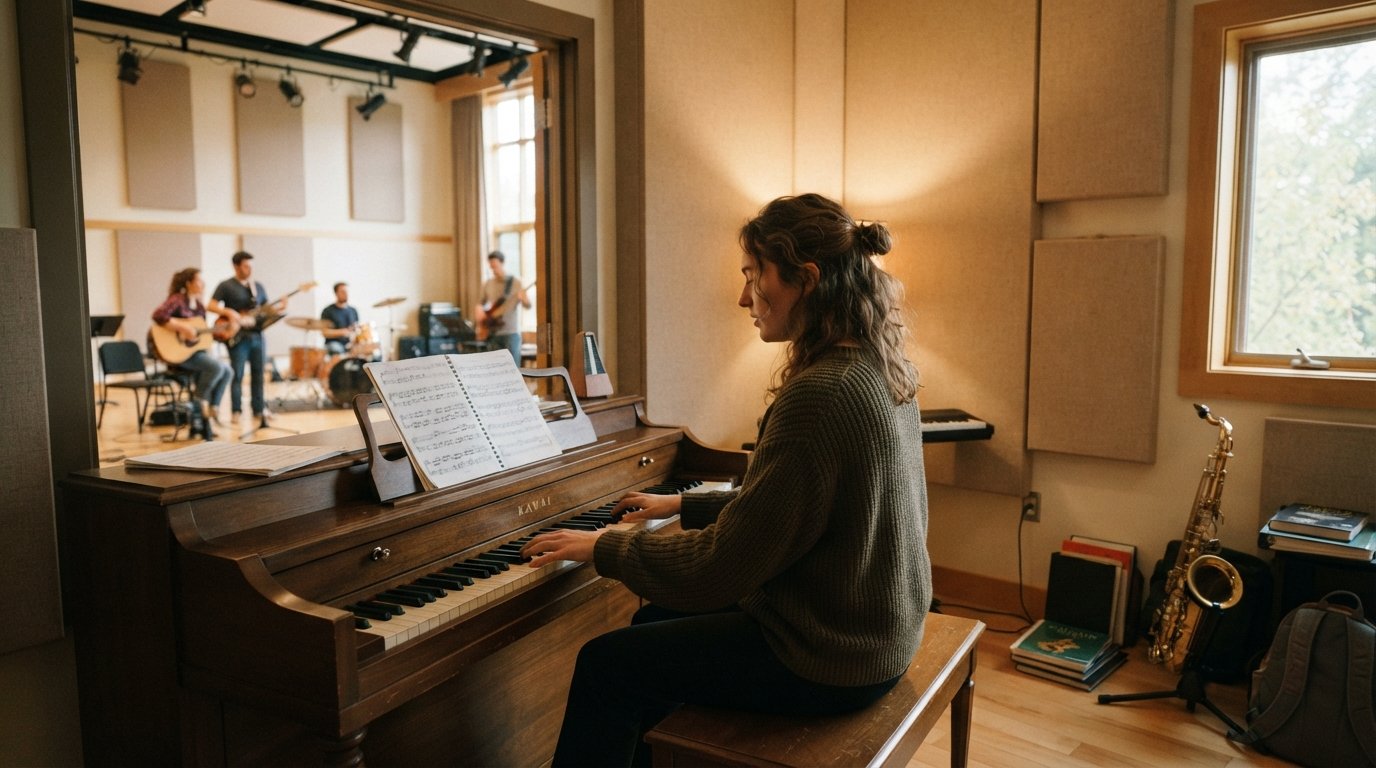
The curriculum is built around four pillars: music theory, ear training, ensemble performance, and applied instruction. In music theory, you learn how to read and write notation, understand scales, intervals, chords, and basic harmonic progressions. Ear training develops your ability to identify pitches, rhythms, and chord qualities by listening alone, a skill that is essential for any working musician. Ensemble performance gives you real-world experience playing or singing with others, whether in a jazz band, choir, chamber group, or world music ensemble. Applied instruction consists of private or small-group lessons on your primary instrument or voice.
Most students take a sequence of courses that includes Music Theory I and II, Musicianship (ear training) I and II, at least one ensemble course per semester, and individual lessons. Some students also choose electives such as Introduction to Music Technology, Songwriting, or Music Business. The exact number of units required for the certificate is typically around 18 to 24 semester units, depending on the catalog year and your specific course selections. Because all courses are offered in person, you will need to plan your commute and schedule accordingly.
One of the strengths of Chabot College's music program is its faculty. Many instructors are active performers and composers in the Bay Area, which means they bring current industry knowledge into the classroom. They also serve as mentors, helping students prepare for auditions, build portfolios, and navigate the local music scene. If you are considering a similar fast-track credential in another health-related field, you might also look at our guide on Fast-Track Phlebotomy Certificate: 12-Week In-Person Program to compare how different short-term programs are structured.
Course Sequence and Scheduling Options
To complete the certificate in 12 weeks, you would need to enroll full-time and take a heavy load of music courses, possibly five or more classes at once. This is feasible if you are not working full-time or have flexible hours. The 12-week option is most common among students who are retraining quickly for a specific job or who want to transfer to a four-year school as soon as possible. If you need to work while studying, you can spread the same courses over two semesters (about 6 to 8 months) or three semesters (up to one year). The less-than-one-year timeframe is the standard track for most students.
Because courses are sequential (Theory I before Theory II, Musicianship I before Musicianship II), you cannot compress the entire program into a few weeks. The 12-week minimum assumes that some courses are offered in an accelerated format or that you have already completed some prerequisites. In practice, most students finish in two semesters, which is still well under a year. You should meet with a Chabot College music advisor to map out your specific plan, especially if you have prior coursework or transfer credits.
Admission Requirements and How to Apply
Chabot College is a public community college, so admission is open to anyone with a high school diploma or equivalent. There is no audition required to enter the Music General Certificate program, although you may need to audition for specific ensembles or placement in applied lessons. The application process is straightforward: apply online through the college's admissions portal, submit proof of residency (if you are a California resident), and take any required placement tests for English and math. Music theory and ear training courses may have their own placement recommendations, but these are usually determined by a brief diagnostic exam or a conversation with the instructor.
International students should check additional requirements, including visa status and English proficiency. Because the program is in person, you will need to be physically present on campus in Hayward. This is not a hybrid or online certificate. If you are relocating, factor in housing and transportation costs. The college does not provide on-campus housing, but there are many rental options nearby.
Tuition for California residents is among the lowest in the country. For the 2025-2026 academic year, in-state tuition is approximately $46 per unit, plus campus fees. A 24-unit certificate would cost roughly $1,100 to $1,400 in tuition and fees. Non-resident tuition is significantly higher, often $300 or more per unit. Financial aid, including the California College Promise Grant (formerly the Board of Governors Fee Waiver), can cover tuition for eligible students. Many students also qualify for federal Pell Grants and work-study. For a broader look at how to evaluate college costs and degree pathways, CollegeDegrees.School offers extensive resources on higher education planning.
Career Outcomes and Transfer Pathways
Graduates of the Music General Certificate are prepared for several entry-level roles. Some find work as private music teachers, either independently or through community music schools. Others become music directors at churches or community centers, performers in local bands or ensembles, or assistants in recording studios. The certificate also provides a solid foundation for further study. If you decide to pursue an associate degree in music at Chabot, you can apply most or all of your certificate units toward that degree. If you transfer to a California State University or University of California campus, your music theory and musicianship courses may satisfy lower-division requirements, though you should confirm with the receiving institution.
It is important to be realistic about salary expectations. Entry-level music teaching or performance work often pays modestly at first, and many musicians hold multiple part-time roles. However, the skills you gain in this program, discipline, collaboration, critical listening, and technical proficiency, are transferable to other fields such as audio engineering, event production, arts administration, and even software development for music technology. Some students use the certificate as a launchpad into those adjacent careers.
If you are considering a career change into a healthcare field instead, the phlebotomy certificate mentioned earlier is another short-term option worth comparing. But for those passionate about music, Chabot's program offers a rare combination of low cost, hands-on training, and a supportive artistic community.
Is the Music General Certificate Right for You?
This program is a good fit if you meet a few key criteria. You want to study music in person, not online. You are comfortable with an intensive schedule if you choose the 12-week option. You are looking for a credential that can lead to immediate work or further education. You are willing to commit to regular practice and ensemble participation. You live near Hayward or are willing to commute. If most of these describe you, the certificate is likely a strong choice.
On the other hand, if you need a fully online program, or if you want a four-year degree without ever attending a physical campus, this is not the right fit. Similarly, if your goal is to become a certified music teacher in public schools, you will eventually need a bachelor's degree and a teaching credential, though the certificate can be your first step. If you are unsure, consider sitting in on a class or attending a student performance at Chabot to get a feel for the environment.
One practical way to decide is to list your short-term and long-term goals. In the short term, do you want to improve your musicianship, build a portfolio, or get a job in music within a year? In the long term, do you see yourself teaching, performing, producing, or working in a music-related business? The certificate serves short-term goals directly and long-term goals indirectly by providing a foundation. It is also a low-risk way to test whether music is the right career path before investing in a more expensive degree.
Comparing Chabot to Other Options
Many community colleges in California offer similar music certificates, but Chabot stands out for its location in the East Bay, its diverse student body, and its strong transfer agreements with nearby universities. The 12-week to less-than-one-year completion window is relatively fast compared to some programs that require two full years. However, other colleges may offer more electives in music technology or commercial music. If you are specifically interested in audio production, you might look for a program with a recording studio emphasis. Chabot does have basic technology courses, but it is not a dedicated audio engineering school.
Private music conservatories and for-profit schools often charge much higher tuition and may not be regionally accredited in the same way. Chabot College is accredited by the Western Association of Schools and Colleges (WASC) Senior College and University Commission, which means its credits are widely recognized. This is important if you plan to transfer or apply for financial aid. Always verify accreditation before enrolling in any program, especially short-term certificates that promise quick job placement.
Another factor to consider is the time commitment outside of class. For every hour in a music theory or ear training class, you should expect to spend two to three hours practicing and completing assignments. Ensemble rehearsals and lessons add more. If you choose the 12-week track, you will be immersed in music daily. That can be exhilarating or exhausting, depending on your personality and other obligations. The less-than-one-year track spreads the load more evenly and is usually more sustainable for working adults.
Steps to Enroll and Succeed
If you are ready to move forward, here is a practical sequence to follow. First, visit the Chabot College website and review the current Music Department course listings and certificate requirements. Second, apply to the college if you are a new student, and submit any transcripts from previous colleges. Third, contact the music department to schedule an advising appointment. Fourth, register for your first-semester courses as early as possible, because music classes often fill up. Fifth, apply for financial aid and scholarships, even if you think you will not qualify. Sixth, attend orientation and get your student ID, parking pass, and any instrument rental information.
Once you are enrolled, success depends on consistent practice and attendance. Here are a few habits that help students finish on time:
- Practice your primary instrument or voice for at least 30 to 60 minutes daily, even on busy days.
- Form a study group with classmates for theory and ear training, since these subjects benefit from peer quizzing.
- Attend office hours and ask instructors for feedback on your weaknesses.
- Record your practice sessions and listen back to track progress.
- Take advantage of campus resources like the library, tutoring center, and performance workshops.
These habits not only help you complete the certificate but also prepare you for the professional demands of a music career. Reliability, preparation, and collaboration are just as important as talent in the working world.
Financial Aid and Cost-Saving Tips
Cost is a major concern for many students, but Chabot College is one of the most affordable options in the region. In addition to the California College Promise Grant, which waives tuition for qualifying students, there are federal grants, state grants, and private scholarships for music students. The Chabot College Foundation offers several scholarships specifically for arts and music majors. You can also look for external scholarships from organizations like the Music Teachers National Association, local community bands, and religious institutions.
Another way to reduce costs is to purchase used textbooks and rent or borrow instruments when possible. The college may have a limited number of instruments available for loan, especially for students in ensemble courses. If you need to buy an instrument, consider buying used from a reputable dealer or a graduating student. For music software, many companies offer student discounts. Finally, consider taking some non-music general education courses at a lower-cost community college if you plan to transfer, but note that the certificate itself does not require general education courses outside of music.
If you are comparing this program to a four-year degree, keep in mind that the certificate is not intended to replace a bachelor's degree. It is a focused credential that gets you started quickly. Many students use it as a stepping stone and then transfer to a CSU or UC campus to complete a bachelor's degree in music or music education. The credits you earn at Chabot are generally transferable, which can save you thousands of dollars compared to starting at a four-year school.
Final Thoughts on the Chabot College Music Certificate
The Music General Certificate at Chabot College offers a fast, affordable, and hands-on way to build a foundation in music. Whether you complete it in 12 weeks or take up to a year, you will gain practical skills, ensemble experience, and a credential that can lead to entry-level work or further study. The in-person format provides irreplaceable interaction with instructors and fellow musicians, and the low tuition makes it accessible to a wide range of students. If you are ready to take the next step, visit the Chabot College website, contact the music department, and start planning your schedule. With careful planning and consistent effort, you can complete this certificate in less than a year and move closer to your musical goals.