
Chatham Environmental Science Bachelor's Degree Guide
Chatham's in-person Environmental Science Bachelor's degree takes four years and combines field research with sustainability training. See costs, careers, and transfer tips.

By Oliver Brooks
Choosing where to study environmental science can feel like standing at a trailhead with a dozen unmarked paths. One route leads to a research lab, another to a policy office, and another to a field station deep in a forest. The Environmental Science Bachelor's degree, usually 4 years In-person at Chatham University, offers a structured way to explore all of those paths before you commit to a single direction. Located in Pittsburgh, Pennsylvania, Chatham pairs a liberal arts foundation with hands-on ecological fieldwork, giving students a rare mix of scientific rigor and real-world application.
For adult learners and career changers weighing their options, understanding what this specific program involves (and how it compares to online alternatives) can save months of uncertainty. This guide breaks down the curriculum, admission expectations, costs, career outcomes, and transfer pathways for the Environmental Science Bachelor's degree, usually 4 years In-person at Chatham University. You will also learn how to decide whether an in-person science degree is worth the investment compared to a flexible online program.
Why Chatham University for Environmental Science?
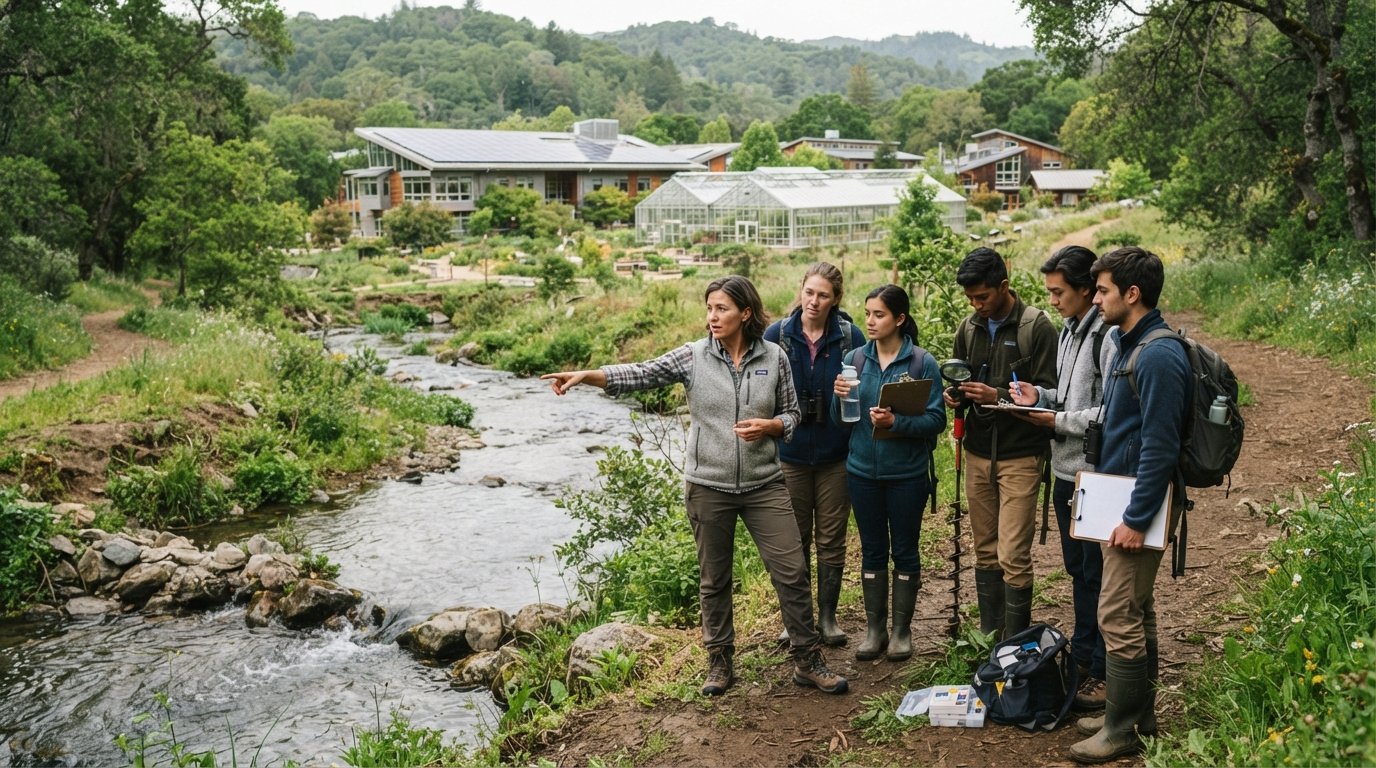
Chatham University has built its reputation around sustainability and environmental studies for decades. Its Eden Hall Campus in Richland Township is one of the first fully sustainable university campuses in the world, generating its own energy, treating its own wastewater, and managing its own food production. For environmental science majors, this is not a backdrop; it is a living laboratory. Students routinely collect water samples, monitor soil health, and analyze renewable energy systems as part of their regular coursework.
The university also maintains strong ties to Pittsburgh's environmental nonprofit sector, government agencies, and green technology firms. That network translates into internship placements, guest lectures, and research collaborations that many smaller programs simply cannot match. If you want to graduate with a resume that already includes real project experience, this kind of embedded access matters.
Another differentiator is class size. Chatham keeps its environmental science cohorts small, which means faculty members know students by name and often invite undergraduates to join their research teams. At larger state universities, those opportunities typically go to graduate students first. Here, undergraduates get first access to fieldwork, lab management, and even co-authorship on published studies.
Program Structure: What Four Years Looks Like
The Environmental Science Bachelor's degree, usually 4 years In-person at Chatham University, follows a traditional fall and spring semester calendar, with optional summer sessions for accelerated progress. The first two years focus on building a foundation in biology, chemistry, geology, and mathematics. You will also complete general education requirements in writing, humanities, and social sciences, which Chatham views as essential for training scientists who can communicate beyond the lab.
By junior year, students declare a concentration or design an interdisciplinary track with their advisor. Common concentrations include conservation biology, environmental policy, sustainable agriculture, and climate science. Senior year centers on a capstone research project or an extended internship, often completed at a partner organization in the Pittsburgh region. This structure ensures that graduates leave with both theoretical knowledge and a portfolio of applied work.
Here is a simplified semester-by-semester overview of the core sequence:
- Year 1: General Biology I and II, General Chemistry I and II, College Writing, Environmental Issues seminar
- Year 2: Organic Chemistry, Statistics, GIS and Mapping, Introduction to Ecology
- Year 3: Hydrology, Environmental Policy, concentration electives, internship preparation
- Year 4: Advanced research methods, capstone or thesis, professional portfolio, career workshop
The order of these courses can shift based on transfer credits or placement exams, but the overall arc remains consistent. Students who enter with AP or dual-enrollment credits in biology or chemistry often have room to add a minor in fields like data science, public health, or urban planning. That flexibility is one reason the program appeals to students with broad interests rather than a single narrow focus.
If you are also considering a technology-focused path, you might find it useful to compare how computer science programs structure their four-year plans. Our guide on computer science bachelor degree career paths explains how technical degrees balance theory and hands-on projects, which can help you weigh whether environmental science or a computing field better matches your goals.
Admission Requirements and Transfer Pathways
Chatham reviews applications holistically, meaning there is no single test score or GPA cutoff that guarantees admission. That said, successful applicants typically present a high school GPA of 3.0 or higher, completed coursework in biology and chemistry, and at least two years of a foreign language. SAT and ACT scores are optional, but submitting strong scores can strengthen a borderline application.
For transfer students, the process is slightly different. Chatham accepts credits from regionally accredited institutions, and students who have completed an associate degree in environmental science or a related field often enter as juniors. The key is to submit official transcripts early and work with an admissions counselor to map which credits apply to the major. Some students find that a few additional courses are needed to satisfy Chatham's specific core requirements, even if they have already earned a two-year degree elsewhere.
Adult learners and career changers should note that Chatham offers advising specifically for non-traditional students. This includes help with prior learning assessment, which can award credit for professional experience in fields like conservation, environmental consulting, or sustainability management. While the program is designed for in-person attendance, some general education courses may be available in hybrid formats, giving working adults a bit more flexibility.
Cost, Financial Aid, and Return on Investment
Tuition for the Environmental Science Bachelor's degree, usually 4 years In-person at Chatham University, falls in the mid-range for private universities in Pennsylvania. For the 2026-2027 academic year, undergraduate tuition is approximately $42,000 per year, with room and board adding another $13,000 to $15,000 depending on the housing option. Books, supplies, and personal expenses typically add $2,000 to $3,000 annually.
Financial aid can significantly reduce that sticker price. Chatham awards merit scholarships to incoming students based on GPA and test scores, and need-based grants are available through the FAFSA. Pennsylvania residents may also qualify for state grants. Environmental science majors are eligible for several external scholarships, including awards from the Environmental Protection Agency, the National Wildlife Federation, and local conservation groups. Combining these sources can bring the net cost down to a level comparable with public universities.
To estimate your actual cost, follow these steps:
- Complete the FAFSA as early as possible to maximize need-based aid.
- Submit the Chatham merit scholarship application by the priority deadline.
- Search external databases for environmental science-specific awards.
- Ask the financial aid office for a written net price estimate before committing.
In terms of return on investment, environmental science graduates from Chatham report starting salaries between $45,000 and $58,000, depending on the sector. Government agencies and nonprofits tend to pay less, while environmental consulting firms and corporate sustainability departments pay more. Over a decade, the degree typically pays for itself, especially for students who secure internships that lead to full-time offers. For a broader look at how different degree fields compare on cost and career outcomes, CollegeDegrees.School provides independent resources on college degree planning and career pathways.
Career Outcomes After Graduation
Graduates with an Environmental Science Bachelor's degree, usually 4 years In-person at Chatham University, pursue a wide range of roles. The most common entry-level positions include environmental scientist, conservation technician, sustainability coordinator, and environmental compliance analyst. Many graduates also continue to graduate school in fields like ecology, environmental engineering, or public policy.
Pittsburgh's regional economy has a growing demand for environmental professionals, particularly in air quality management, brownfield remediation, and renewable energy planning. Chatham's alumni network is active in these sectors, and the university's career services office maintains a job board specifically for sustainability and environmental roles. Students who complete internships with agencies like the Pennsylvania Department of Environmental Protection often receive priority consideration for open positions after graduation.
For those who want to move into leadership or research roles, a master's degree is usually required. Chatham offers a Master of Sustainability and a Master of Arts in Food Studies, both of which integrate well with the undergraduate environmental science curriculum. Staying for a fifth year through an accelerated pathway can be a cost-effective way to earn both degrees.
In-Person vs. Online: Which Format Fits You?
The in-person format at Chatham offers clear advantages for environmental science: access to labs, field equipment, and face-to-face mentorship. Environmental science is a discipline rooted in observation and measurement, and those skills are difficult to master through a screen alone. Students who thrive in collaborative, hands-on settings tend to get the most out of the residential experience.
That said, online environmental science degrees have improved significantly in recent years. Some accredited programs now include virtual labs, remote data analysis projects, and local fieldwork supervised by partner organizations. For working adults who cannot relocate or commute, an online option may be the only realistic path to a degree. If you are exploring that route, DegreesOnline.Education offers detailed comparisons of accredited online degree programs across multiple fields, including science and engineering.
Before deciding, ask yourself these questions:
- Do I learn best by doing, or can I absorb material through reading and video?
- Can I commit to a fixed class schedule four days a week?
- Will I need to work full-time while earning my degree?
- Do I want to build a local professional network in a specific region?
If you answered yes to the first or second question, the in-person program at Chatham is likely the better fit. If you answered yes to the third, an online or hybrid program may be more practical. There is no single right answer, only the answer that matches your circumstances.
Making the Decision
The Environmental Science Bachelor's degree, usually 4 years In-person at Chatham University, is a strong choice for students who want a rigorous, field-based education with a sustainability focus. The program's small size, committed faculty, and access to the Eden Hall Campus create opportunities that are hard to replicate elsewhere. At the same time, the cost and time commitment are significant, and prospective students should weigh those factors carefully against their career goals and personal obligations.
If you are still in the exploratory phase, start by visiting the campus, sitting in on a class, and talking with current students. Ask about internship placements, research projects, and what graduates are doing now. Those conversations will tell you more than any brochure. And if you are comparing this program to online alternatives, take advantage of the free comparison tools and guides available on DegreesOnline.Education to see how Chatham stacks up against other accredited options. The right degree is the one that moves you toward the career you actually want.