
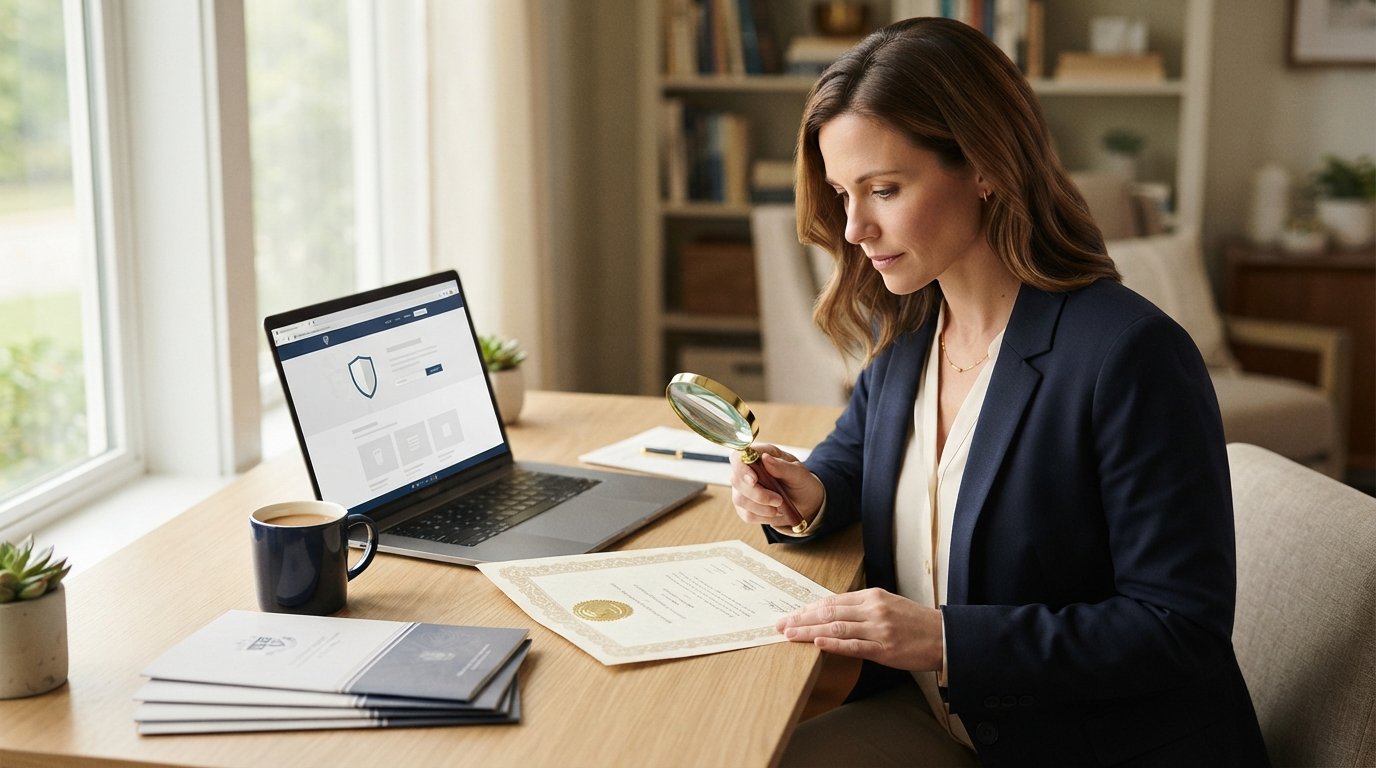
Check if an Online Degree Is Accredited: 6 Steps
Learn how to check if an online degree is accredited in six simple steps and protect your career investment from diploma mills.

By Madison Cooper
You have found the perfect online degree program. The curriculum matches your career goals, the tuition fits your budget, and the schedule works around your full-time job. Before you submit an application or commit to a single course, you need to verify one critical detail: accreditation. Without proper accreditation, your degree may hold little value with employers, graduate schools, and professional licensing boards. Learning how to check if an online degree is accredited can save you from wasting thousands of dollars and years of effort on a credential that does not advance your career.
Accreditation is a voluntary, peer-reviewed process that evaluates the quality of educational institutions and their programs. In the United States, the Department of Education and the Council for Higher Education Accreditation (CHEA) recognize specific accrediting agencies. These agencies review schools for academic rigor, faculty qualifications, student support services, and financial stability. When a school earns accreditation, it signals that its degrees meet established quality standards. For you, the student, that signal matters for financial aid eligibility, credit transfers, and employer recognition.
The stakes are especially high for adult learners and working professionals who need a flexible path to career advancement. An unaccredited degree can derail your plans for a promotion, a license, or a graduate program. Fortunately, the verification process is straightforward. You just need to know where to look and what questions to ask. This guide walks you through six practical steps to confirm that your chosen online degree program holds legitimate accreditation.
Step 1: Start With the School's Official Website
The first place to look for accreditation information is the institution's own website. Most reputable colleges and universities display their accreditation status prominently on their homepage, usually in the footer or under an "About Us" or "Accreditation" section. You should look for the name of the accrediting agency, not just a vague claim that the school is "accredited." A legitimate school will proudly name its accreditor because that recognition adds credibility.
However, you should treat the school's website as a starting point, not the final answer. Some institutions use misleading language about their status. For example, a school might claim to be "state approved" or "licensed to operate," which is not the same as regional or national accreditation. Others might list an accrediting agency that is not recognized by the Department of Education or CHEA. These unrecognized agencies are often called "diploma mills" or "accreditation mills," and their stamps of approval carry no real value.
When you find the name of the accrediting body on the school's site, write it down. You will need it for the next step. If the site does not list any accrediting agency, or if the information is vague, consider that a major red flag. A legitimate institution has nothing to hide and will gladly share its accreditation details.
Step 2: Verify the Accrediting Agency With the U.S. Department of Education
The U.S. Department of Education maintains a searchable database of accredited postsecondary institutions and programs. This database, called the Database of Accredited Postsecondary Institutions and Programs (DAPIP), is the most authoritative source for verifying accreditation. You can search by school name, location, or accrediting agency. If your chosen school appears in this database with a current accreditation status, you can proceed with confidence.
The Department of Education also publishes a list of recognized accrediting agencies. This list distinguishes between regional accreditors (such as the Higher Learning Commission and the Southern Association of Colleges and Schools) and national accreditors (such as the Accrediting Commission of Career Schools and Colleges). Both types are legitimate, though regional accreditation is generally considered the gold standard for academic transfer and graduate school admission. You can check this list to confirm that the agency named by your school is actually recognized by the federal government.
Here is what you should look for when you search the database:
- Current status: The school must have a "recognized" or "accredited" status, not "candidate" or "probationary" unless you fully understand the implications.
- Agency match: The accrediting agency listed in the database should match the one named on the school's website.
- Program-level accreditation: Some fields, like nursing, business, and engineering, have additional program-specific accreditors. Your degree program, not just the school, should carry the appropriate accreditation.
After you confirm the school's institutional accreditation, dig deeper. Check whether the specific online program you want to enroll in is also accredited. Some schools have institutional accreditation but offer programs that lack program-level approval. For example, an MBA from a regionally accredited school might not be accredited by the Association to Advance Collegiate Schools of Business (AACSB). That distinction can affect your career options in competitive business fields.
Step 3: Check the Council for Higher Education Accreditation (CHEA) Database
CHEA is another reliable source for verifying accreditation. This nonprofit organization recognizes accrediting agencies that meet its quality standards. Its website includes a searchable directory of recognized agencies and a database of accredited institutions. While the Department of Education database focuses on federal recognition, CHEA adds an extra layer of credibility because it evaluates the accrediting agencies themselves.
You can use the CHEA database to cross-reference the school you are considering. If the school appears in both DAPIP and the CHEA directory, you can be confident that it meets recognized standards. If the school appears in one but not the other, look into the discrepancy. There may be a simple explanation, such as a recent change in accreditation status, but you want to understand the details before you enroll.
Keep in mind that some legitimate specialized accreditors are recognized by CHEA but not by the Department of Education. The reverse is also true. For most students, the safest approach is to confirm that the school and program are accredited by an agency recognized by both organizations. This dual recognition provides the strongest protection for your investment in education.
Step 4: Contact the Accrediting Agency Directly
If you cannot find clear information online, or if you want absolute certainty, contact the accrediting agency directly. Accrediting agencies maintain lists of schools and programs they have approved. A quick phone call or email can confirm whether your chosen online degree program is currently accredited. This step is especially useful if you are considering a newer online program that may not yet appear in the major databases.
When you contact the agency, ask specific questions about the school's status. For instance, you might ask whether the institution has any sanctions, probationary status, or pending actions. You can also ask about the agency's complaint process. A legitimate agency will have a clear procedure for investigating student complaints about accredited schools. If the school refuses to name its accreditor, or if the accreditor does not respond to your inquiry, treat that as a serious warning sign.
Direct contact also helps you understand the scope of the accreditation. Some agencies accredit the entire institution, while others accredit specific programs or campuses. An online degree might be offered through a different branch or subsidiary than the main campus. Confirm that the online arm of the school holds the same accreditation as the brick-and-mortar campus. In some cases, the online division has a separate accreditation status, which can affect financial aid and transfer credits.
Step 5: Look for Program-Specific Accreditation in Professional Fields
Certain careers require more than a degree from an accredited institution. Fields like nursing, teaching, social work, engineering, and law have their own accrediting bodies. If you are pursuing a professional degree, you must verify that the program itself holds the appropriate specialized accreditation. For example, a nursing degree should be accredited by the Commission on Collegiate Nursing Education (CCNE) or the Accreditation Commission for Education in Nursing (ACEN). Without this accreditation, you may not be eligible to sit for the licensing exam in your state.
This step is critical for career changers who are entering regulated professions. An accredited online degree in a non-regulated field, like communications or history, is generally sufficient for most employers. But in regulated fields, the program-level accreditation is non-negotiable. Before you enroll, check the requirements for the license or certification you plan to pursue. Then confirm that the program's accreditation meets those requirements.
Here are a few examples of program-specific accreditors:
- Business: AACSB, Accreditation Council for Business Schools and Programs (ACBSP)
- Nursing: CCNE, ACEN, Commission on Collegiate Nursing Education
- Engineering and Technology: ABET (Accreditation Board for Engineering and Technology)
- Education: Council for the Accreditation of Educator Preparation (CAEP)
- Psychology: American Psychological Association (APA) for doctoral programs
Once you confirm both institutional and program-level accreditation, you can focus on other factors like curriculum, faculty, and student support. But do not skip the program-level check. Employers in regulated fields often verify accreditation before they hire or promote. A degree that does not meet the professional standard will limit your options, no matter how well the program prepared you.
Step 6: Beware of Diploma Mills and Accreditation Mills
Diploma mills are institutions that offer degrees with little or no academic work in exchange for payment. Accreditation mills are organizations that grant accreditation to these institutions without any meaningful review. Together, they create a market for fake degrees that can ruin your career prospects. Learning how to check if an online degree is accredited includes recognizing these deceptive practices.
There are several red flags that signal a diploma mill or accreditation mill. The school might advertise a degree based on "life experience" alone, or it might promise a degree in a matter of weeks. The tuition might be suspiciously low, or the school might pressure you to enroll with high-pressure sales tactics. The website might lack a physical address, faculty credentials, or a catalog of courses. If you see any of these signs, walk away.
To protect yourself, always verify accreditation through independent sources like DAPIP and CHEA. Do not rely on the school's own claims or on a seal displayed on its website. A diploma mill can easily copy a legitimate seal or invent a fake accrediting agency. Cross-referencing multiple independent databases is your best defense. If a school claims accreditation from an agency you cannot find on the federal or CHEA list, that agency is likely a mill.
You should also be cautious with schools that have "provisional" or "candidate" status. This status means the school is working toward accreditation but has not yet achieved it. While some legitimate new institutions operate as candidates, the status is not a guarantee of eventual accreditation. If your program is still a candidate, you risk losing your credits if the school fails to achieve full accreditation. For most students, it is safer to choose a fully accredited program.
Why Accreditation Matters for Your Career and Finances
Accreditation affects more than your resume. It determines whether you can receive federal financial aid, whether your credits transfer to other institutions, and whether graduate schools will accept your degree. The U.S. Department of Education only allows students at accredited schools to access federal grants and loans. If you enroll in an unaccredited program, you will have to pay entirely out of pocket. That financial burden can be significant, especially for a degree that may not help your career.
Employers also check accreditation. Many human resources departments verify degrees through background checks that include accreditation status. If your degree comes from an unaccredited school, the employer might reject your application or rescind a job offer. In regulated professions, the licensing board will simply refuse to recognize your degree, making it impossible to practice in your chosen field. These consequences are why verifying accreditation before you enroll is so important.
For adult learners who are balancing work and family, the stakes feel even higher. You are investing not just money, but also time that you could spend with your family or advancing in your current job. A wasted educational investment sets you back years. Fortunately, the steps in this guide take only a few minutes to complete. You can check the databases, contact the agencies, and confirm the accreditation status before you fill out a single application.
If you are planning to transfer credits from a previous institution, accreditation also matters for transfer decisions. Most accredited schools only accept credits from other accredited schools. You can read more about the process in our guide on how to transfer credits to an online degree program easily. This resource explains how to evaluate your previous coursework and ensure your hard work counts toward your new degree.
Use Multiple Sources and Trust Your Instincts
The best approach to verifying accreditation is to use multiple independent sources. Start with the school's website, then cross-reference that information with the Department of Education database and the CHEA directory. If the information matches across all three, you can feel confident in the school's status. If you find discrepancies, investigate before you commit. A quick email to the accrediting agency or the state education department can clarify the situation.
You should also trust your instincts during the research process. If something feels off about the school's marketing, its admissions process, or its accreditation claims, take the time to dig deeper. Legitimate institutions are transparent about their accreditation. They provide clear documentation and encourage prospective students to verify their status. If a school is evasive or defensive when you ask about accreditation, that is a strong signal to look elsewhere.
Finally, remember that accreditation is not a one-time event. Schools must undergo periodic reviews to maintain their accredited status. While your degree will remain valid if the school later loses accreditation, the school's current status matters for your financial aid and for the value of your degree in the job market. Before you enroll, confirm that the school is in good standing with its accrediting agency. After you enroll, you can periodically check the databases to stay informed.
Verifying accreditation is one of the most important steps you can take before starting an online degree. It protects your financial investment, ensures your credits are transferable, and secures the value of your degree with employers and licensing boards. By following the six steps in this guide, you can move forward with confidence, knowing that your online education will open doors rather than close them. For a broader overview of your options, you can also check resources like CollegeDegrees.School, which provides guidance on degree pathways and career planning. Take the time to verify, ask questions, and choose a program that meets recognized quality standards. Your future career depends on it.