
Culinary Arts Associate's Degree at CCCC: 2-Year Chef Training
The Culinary Arts/Chef Training Associate's degree, usually 2 years In-person at Central Carolina Community College, builds hands-on skills and management know-how for restaurant careers.

By Lucas Scott
For aspiring chefs who want to trade the uncertainty of on-the-job trial and error for structured, hands-on training, the Culinary Arts/Chef Training Associate's degree, usually 2 years In-person at Central Carolina Community College, offers a direct and practical path. This program blends kitchen fundamentals, restaurant management, and real production experience into a single credential that employers recognize. If you are weighing a fast-track certificate against a full degree, or wondering how a two-year commitment compares with four-year hospitality programs, this guide breaks down what the program covers, who it suits, and how to decide whether it fits your career goals.
Central Carolina Community College (CCCC) serves students across Chatham, Harnett, and Lee counties in North Carolina, and its culinary program is rooted in the kind of farm-to-table culture the region is known for. The associate's degree is designed to be completed in roughly two years of full-time study, with classes delivered in person so students spend real hours in commercial kitchens, not just watching videos. That in-person format matters in a field where knife skills, timing, and teamwork cannot be learned from a screen alone.
This article walks through the curriculum, admission steps, costs, career outcomes, and the practical trade-offs of choosing an associate's degree over a certificate or a bachelor's degree. It also explains how financial aid and scholarships can reduce out-of-pocket costs, and how to compare this program with online or hybrid alternatives if location or scheduling is a constraint.
What the Culinary Arts/Chef Training Associate's Degree Covers
The core of the program is classic culinary technique. Students start with sanitation and safety, knife handling, stocks and sauces, and the fundamentals of moist and dry heat cooking. From there, the curriculum expands into baking and pastry, garde manger (cold kitchen work), meat fabrication, and international cuisines. Because the degree is an Associate of Applied Science, it pairs kitchen training with management coursework: food cost control, purchasing and inventory, menu design, and supervision of kitchen staff.
What distinguishes a two-year culinary associate's degree from a short certificate is the breadth of business preparation. A certificate program may teach you to cook well; an associate's degree also teaches you how a kitchen makes money. Graduates are better positioned for roles like sous chef, kitchen supervisor, or small-business owner because they understand labor costs, portion control, and inventory turnover, not just recipes.
Most programs of this type also include a practicum or internship in a working kitchen, which is where classroom skills meet the pace of a real service. Students typically rotate through stations, learn to communicate during a rush, and build the professional habits that employers look for: punctuality, cleanliness, and the ability to take direction under pressure.
Typical Coursework and Skill Milestones
While exact course titles vary by institution, a two-year culinary associate's degree generally follows a sequence that builds from basic to advanced. In the first year, students focus on technique and safety; in the second, they move into management, advanced production, and externship placements. The following list reflects the kind of milestones students can expect as they progress:
- First semester: sanitation certification, knife skills, basic cooking methods, and kitchen math.
- Second semester: stocks, sauces, soups, baking fundamentals, and introductory nutrition.
- Third semester: meat and seafood fabrication, garde manger, international cuisine, and food cost control.
- Fourth semester: menu planning, purchasing, supervision, capstone production, and an externship or practicum.
That progression is deliberate. Each course assumes the skills from the one before it, so students who work while enrolled should plan their schedules carefully. Part-time enrollment is often possible, but it stretches the timeline beyond the usual two years.
Why the In-Person Format Matters for Chef Training
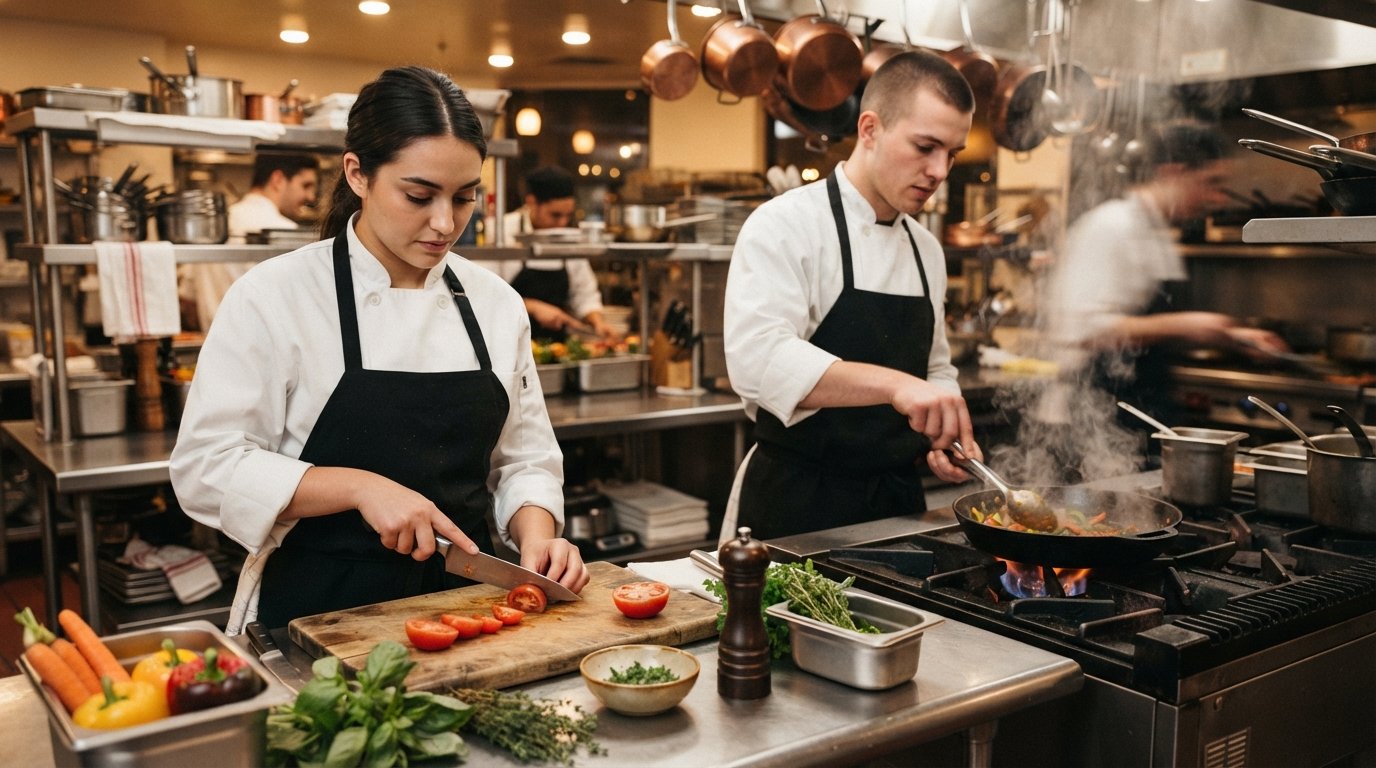
Culinary education is one of the few fields where online learning has real limits. You can study food safety theory online, but you cannot develop muscle memory for a consistent julienne or learn to taste and adjust a sauce by watching a lecture. The in-person requirement at CCCC means students work in teaching kitchens with commercial equipment: ranges, convection ovens, walk-in coolers, and industrial dish machines. They also learn to work as a brigade, which is the closest simulation of a professional kitchen environment available before employment.
For adult learners juggling jobs and family, the in-person format is a genuine trade-off. Classes are scheduled during the day and some evenings, and the program expects regular attendance because kitchen work is collaborative. Prospective students should confirm current scheduling options with the college before committing, since lab times and cohort start dates can change. The payoff is a credential backed by hundreds of hours of supervised kitchen practice, which is what many employers in restaurants, hotels, and institutional food service want to see.
Students who need more flexibility sometimes compare local, hands-on programs with distance options. If you are exploring how associate degrees work in other states or through remote formats, our guide to affordable associate degrees through distance learning in Connecticut explains how online delivery is structured for programs that can be taught remotely, which helps put the in-person culinary model in context.
Admissions, Costs, and Financial Aid
Admission to a community college culinary program is generally open-access compared with four-year hospitality schools. Applicants typically need a high school diploma or equivalent, completion of placement requirements in math and English, and compliance with college health and safety forms. Some programs require a brief interview or a prospective student advising session before registration. Because the degree includes kitchen labs, students should also expect to purchase a knife kit, uniforms, and non-slip shoes, which are separate from tuition.
Cost is one of the strongest arguments for the community college route. North Carolina residents pay in-state tuition rates at CCCC, and the total cost of a two-year associate's degree is usually a fraction of a private culinary school's tuition. Financial aid options include federal grants and loans, state grants, institutional scholarships, and work-study placements. Students should file the FAFSA early and ask the financial aid office about culinary-specific scholarships, which are sometimes funded by local restaurant associations or foundations.
External scholarship databases can supplement college-based aid. Scholarship.Education is a comprehensive online resource that helps students discover, evaluate, and apply for scholarships and financial aid opportunities, and it is a useful starting point for adult learners who are returning to school and may not know where to look beyond federal aid.
Prospective students should also ask about transfer policies. Some four-year hospitality management programs accept culinary associate's degree credits, which allows graduates to pursue a bachelor's degree later without starting over. That pathway can be valuable for students who want to move into hotel management, food service administration, or dietetics.
Career Outcomes and Salary Expectations
Graduates of a culinary arts associate's degree typically enter the workforce in line cook, prep cook, or station chef roles, then advance to sous chef, kitchen manager, or executive chef positions with experience. Others move into catering, institutional food service (schools, hospitals, senior living), food sales, or entrepreneurship. The degree also supports roles that blend cooking with business, such as kitchen supervisor or food truck owner, where cost control and menu planning skills matter as much as technique.
Salary expectations vary widely by region, establishment type, and experience. Entry-level kitchen pay is modest in most markets, and advancement depends heavily on demonstrated skill and reliability. Students should think of the degree as a credential that accelerates promotion rather than a guarantee of high starting pay. The Bureau of Labor Statistics projects continued demand for chefs and head cooks, and the restaurant industry's recovery patterns since 2020 have increased demand for trained supervisors who can manage labor and food costs.
For career changers, the degree also signals commitment. A two-year credential with an externship shows employers that a candidate has chosen the field deliberately, which can matter when competing against applicants with only informal experience.
How to Decide If This Program Fits Your Goals
The right choice depends on your timeline, budget, and career target. A certificate is faster and cheaper but narrower; a bachelor's degree in hospitality management opens more corporate and administrative doors but takes longer and costs more. The associate's degree sits in the middle: it is long enough to build real skill and management knowledge, but short enough to enter the workforce quickly.
Prospective students should visit the campus, tour the kitchens, and talk with instructors about externship placements and graduate outcomes. Ask specific questions: Where do graduates work? What is the externship process? How many students finish in two years? What support exists for adult learners who work full time? The answers will tell you more than any brochure.
It also helps to map the decision against your finances. Compare total tuition, fees, tools, and living costs against expected entry-level wages, and factor in scholarships and grants. Students who plan carefully can often finish with little or no debt, especially at in-state community college rates.
Final Thoughts on the Two-Year Culinary Path
The Culinary Arts/Chef Training Associate's degree, usually 2 years In-person at Central Carolina Community College, is a practical investment for students who want hands-on training, business fundamentals, and a credential employers recognize, without the cost and time of a four-year program. It suits career changers, recent high school graduates, and working adults who can commit to in-person lab time. Before enrolling, confirm current tuition, scheduling, and admission requirements directly with the college, and explore scholarship options early. With realistic expectations and a clear career target, a two-year culinary degree can be the foundation for a durable and rewarding career in food service.