
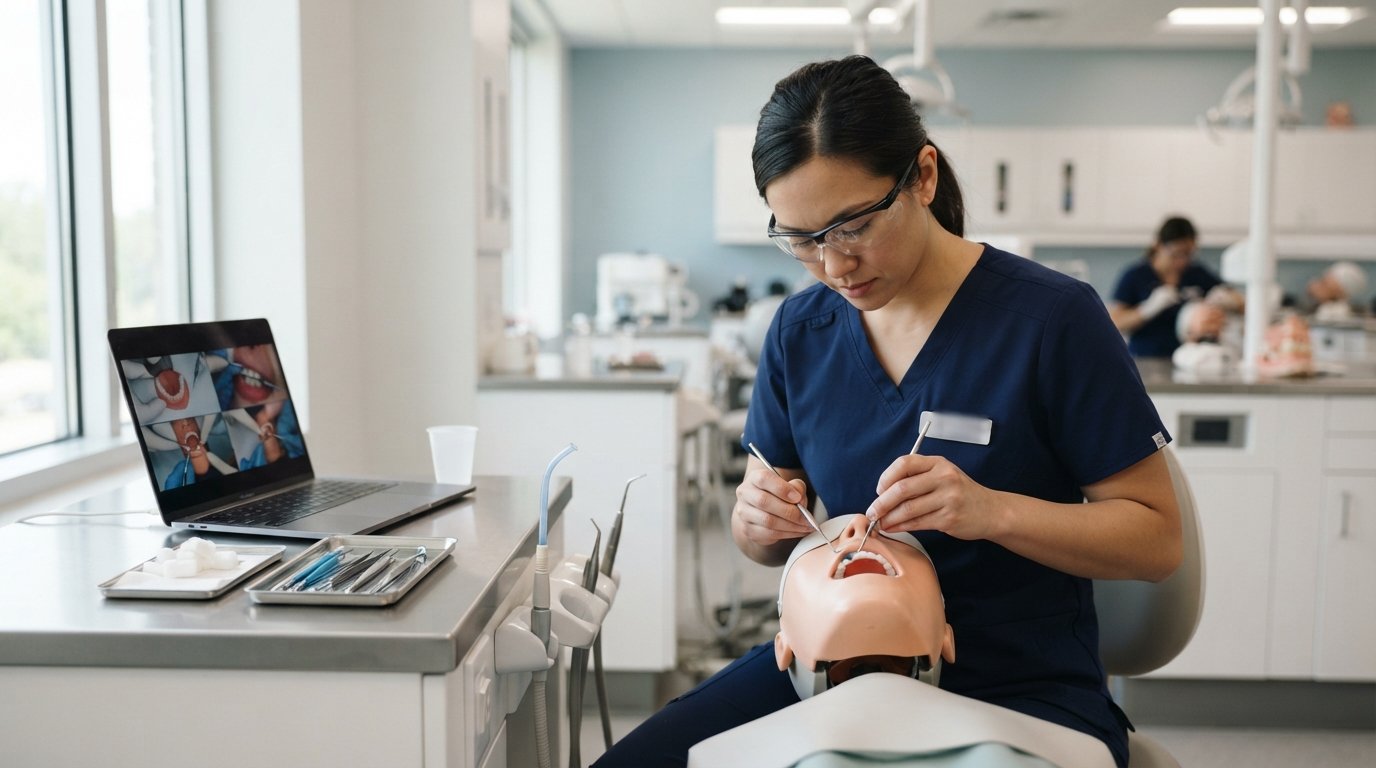
Dental Assisting Certificate Online at East Ohio College
Earn a Dental Assisting/Assistant Certificate, 1 year to less than 2 years Online at East Ohio College and start a healthcare career with flexible online classes.

By Wendy Young
If you are ready to step into a healthcare career without committing to a four-year degree, a Dental Assisting/Assistant Certificate, 1 year to less than 2 years Online at East Ohio College could be the practical, fast-track credential you need. This program is designed for adults who want hands-on clinical skills, flexible online coursework, and a clear path to employment in a dental office. East Ohio College has built its reputation on career-focused training, and this certificate is no exception: you get the core science, the chairside technique, and the professional polish that dental employers expect, all within a timeline that respects your busy life.
But what does the online format actually look like? How do you complete clinical requirements from a distance? And is a one-year certificate enough to get hired in 2026? This guide answers those questions and more. We will walk through the curriculum, the online learning experience, career outcomes, costs, and the steps to enroll. Along the way, you will see how this program fits into the broader landscape of accredited online colleges, and we will point you to resources that help you compare your options with confidence.
Why a Dental Assisting Certificate Makes Sense in 2026
Dental assisting is one of the most accessible entry points into healthcare. You do not need a bachelor's degree to start, and many dental assistants learn on the job. However, formal training gives you a significant edge: employers prefer candidates who have completed an accredited program because it reduces training time and ensures a baseline of safety and competency. The Dental Assisting/Assistant Certificate, 1 year to less than 2 years Online at East Ohio College is built around that exact premise. It compresses the essential knowledge and hands-on practice into a focused year of study, so you can enter the workforce sooner and start earning.
The demand for dental assistants remains strong. An aging population, expanding access to dental care, and a growing emphasis on preventive services all contribute to steady job openings. According to the Bureau of Labor Statistics, employment of dental assistants is projected to grow faster than the average for all occupations over the next decade. For career changers and working adults, this creates a window of opportunity: you can train for a role that is in demand, offers predictable hours, and provides a genuine sense of purpose.
What sets the East Ohio College program apart is its structure. Rather than requiring you to commute to campus several times a week, the online format lets you complete didactic coursework from home while arranging clinical experiences in approved local settings. That flexibility is a lifeline for students who work full-time, care for family members, or live in areas without easy access to a traditional campus. Before you commit, though, it is wise to understand how accreditation works and how to verify that a program meets your state's requirements. Our guide on how to choose regionally accredited online colleges explains the questions to ask and the red flags to avoid, and it is a helpful companion as you evaluate this certificate alongside other options.
Inside the Online Dental Assisting Certificate Curriculum
The Dental Assisting/Assistant Certificate, 1 year to less than 2 years Online at East Ohio College is structured to deliver both theoretical foundations and practical skills. You will start with core courses in dental anatomy, oral pathology, infection control, and patient communication. These subjects form the language of the dental office, and mastering them early makes the clinical components far less intimidating. From there, you move into chairside procedures: instrument transfer, suctioning, taking impressions, exposing radiographs, and assisting with common treatments like fillings and crowns.
Because the program is online, the didactic portion is delivered through a learning management system. You will watch recorded lectures, participate in discussion boards, complete interactive modules, and take assessments at scheduled intervals. Some courses may include live virtual sessions with instructors, giving you the chance to ask questions in real time. The clinical component is arranged separately: East Ohio College helps you identify a local dental office or clinic where you can complete supervised practicum hours. This is a common model for online allied health programs, and it ensures you graduate with actual hands-on experience, not just book knowledge.
Here is a snapshot of the typical course sequence you might encounter:
- Dental Science Foundations: anatomy, physiology, and microbiology as they relate to the oral cavity.
- Clinical Procedures I and II: instrument identification, four-handed dentistry, moisture control, and chairside assisting techniques.
- Radiography and Imaging: safety protocols, positioning, and digital image processing.
- Dental Materials and Expanded Functions: handling of restorative materials, impression materials, and temporary restorations.
- Practice Management and Professionalism: scheduling, billing, patient records, and communication skills.
Each course is designed to build on the previous one, so the sequence matters. You will also complete a practicum or externship, typically in the final term, where you apply everything you have learned under the supervision of a licensed dentist or experienced assistant. This hands-on phase is often the most valuable part of the program because it bridges the gap between online learning and the realities of a fast-paced dental practice.
How the Online Format Works for Working Adults
One of the biggest concerns prospective students have about an online dental assisting program is whether it can truly prepare them for a hands-on job. The answer is yes, provided the program includes a robust clinical component. East Ohio College addresses this by combining flexible online coursework with arranged local externships. You are not expected to learn chairside skills through a screen; you learn the theory online, then practice those skills in a real dental setting with a mentor.
The online format also offers significant lifestyle benefits. You can study in the evenings, on weekends, or during lunch breaks. There is no commute to campus, which saves both time and money. For students in rural areas or those with irregular work schedules, this flexibility can be the difference between completing a certificate and putting it off indefinitely. That said, online learning requires discipline. You need to set aside regular study hours, stay organized, and communicate proactively with instructors and your clinical coordinator. The program is designed to be rigorous, and the students who succeed are those who treat it like a job.
Another advantage is the ability to review material as often as you need. Recorded lectures and digital resources let you pause, rewind, and revisit complex topics. This is particularly helpful for subjects like dental anatomy or radiography, where repetition and visual learning are key. Many students find that they actually learn better online because they can tailor the pace to their own understanding.
Career Outcomes and Salary Expectations for Dental Assistants
Graduates of the Dental Assisting/Assistant Certificate, 1 year to less than 2 years Online at East Ohio College are prepared for entry-level positions in general dentistry, orthodontics, pediatric dentistry, and oral surgery. Typical job titles include dental assistant, chairside assistant, orthodontic assistant, and sterilization technician. With experience and additional certifications, you can move into roles such as expanded functions dental assistant, office manager, or clinical coordinator.
Salary expectations vary by region, experience, and employer. According to the Bureau of Labor Statistics, the median annual wage for dental assistants was around $44,000 in recent data, with the top 10 percent earning more than $60,000. Pay tends to be higher in metropolitan areas and in specialty practices. Many employers also offer benefits such as health insurance, paid time off, and continuing education reimbursement. For a one-year certificate, the return on investment can be attractive, especially if you secure a position quickly after graduation.
It is important to note that dental assisting is a platform for advancement. Some assistants go on to become hygienists (which requires an associate degree), practice managers, or even dentists. The certificate gives you a foothold in the field and a clear view of the pathways ahead. If you are considering further education, you can explore accredited online bachelor's degrees in healthcare administration or related fields later on. For now, the certificate is a practical, low-risk way to test your interest and start earning.
Admission Requirements and Enrollment Steps
Enrolling in the Dental Assisting/Assistant Certificate, 1 year to less than 2 years Online at East Ohio College is a straightforward process, but it does require some planning. The college typically looks for a high school diploma or equivalent, and you may need to complete an admissions interview or placement assessment. Because the program involves clinical work, you should also be prepared to meet health and safety requirements, such as immunizations, background checks, and CPR certification. These are standard for allied health programs and are usually completed before the externship begins.
Here are the general steps to apply:
- Request information: Visit the East Ohio College website or contact admissions to learn about start dates, tuition, and clinical placement options.
- Complete the application: Submit your application online, along with transcripts and any required fees.
- Meet with an advisor: Discuss your schedule, financial aid options, and clinical site possibilities.
- Enroll and orient: Once accepted, attend orientation and set up your online learning account.
Financial aid is available for eligible students, including federal grants, loans, and institutional scholarships. You can also explore external scholarship opportunities through resources like Scholarship.Education, which maintains a searchable database of awards for students in certificate and degree programs. Taking the time to apply for scholarships can significantly reduce your out-of-pocket costs, so make it part of your enrollment plan.
Accreditation and Program Quality: What to Verify
Accreditation is a critical factor in any healthcare training program. It ensures that the curriculum meets recognized standards and that your credential will be respected by employers and state licensing boards. East Ohio College is accredited by a regional accrediting body, and the dental assisting program may also hold programmatic accreditation from the Commission on Dental Accreditation (CODA). You should confirm the specific accreditation status directly with the college and with CODA before enrolling.
Why does this matter? Some states require dental assistants to complete a CODA-accredited program to perform certain expanded functions, such as taking radiographs or applying sealants. Even if your state does not mandate it, employers often prefer graduates from accredited programs because they know the training is comprehensive. Accreditation also affects your ability to transfer credits if you decide to pursue further education later. Always ask the admissions office for documentation and check the accreditor's website independently.
Beyond accreditation, look at program outcomes: graduation rates, job placement rates, and student satisfaction. East Ohio College publishes some of this data, and you can also ask to speak with recent graduates. A quality program will be transparent about its results and eager to answer your questions.
Costs, Financial Aid, and Return on Investment
The cost of the Dental Assisting/Assistant Certificate, 1 year to less than 2 years Online at East Ohio College varies depending on your residency, credit load, and whether you transfer any prior credits. As a private institution, tuition may be higher than at a public community college, but the accelerated timeline and online format can offset some of that difference. You should request a detailed cost breakdown from the admissions office, including tuition, fees, books, supplies, and any clinical or lab fees.
Financial aid can make the program more affordable. Complete the FAFSA to determine your eligibility for federal grants and loans. State workforce development programs sometimes offer funding for short-term healthcare training, so check with your local workforce board. Additionally, many dental offices offer tuition reimbursement or signing bonuses for assistants who commit to working with them after graduation. It is worth asking about these incentives during job interviews.
When calculating return on investment, consider both the cost of the program and the salary you can expect to earn. If you graduate in one year and secure a full-time position at $40,000 per year, you can often recoup your educational investment within a few years. The key is to avoid unnecessary debt: borrow only what you need, apply for scholarships, and consider working part-time while enrolled.
Comparing Online Dental Assisting Programs
East Ohio College is not the only option for online dental assisting training, so it pays to compare. When evaluating programs, look at the following factors:
- Accreditation: Regional and programmatic accreditation are both important.
- Clinical requirements: How does the program arrange externships, and will they help you find a site near your home?
- Format and flexibility: Are courses asynchronous or synchronous? How long does the program take?
- Cost and financial aid: Compare total tuition and available aid packages.
- Support services: Does the program offer career placement assistance, tutoring, and technical support?
You can also explore broader resources on accredited online colleges to understand how East Ohio College stacks up against other institutions. The right program for you will depend on your budget, location, and career goals. Do not rush the decision; request information from multiple schools and speak with admissions advisors before committing.
Is This Certificate Right for You?
The Dental Assisting/Assistant Certificate, 1 year to less than 2 years Online at East Ohio College is an excellent fit for people who want to enter healthcare quickly, prefer a blend of online learning and hands-on practice, and are comfortable working in a clinical team environment. It is less suitable for those who want a purely academic experience or who are not prepared to arrange and complete an externship. If you are organized, self-motivated, and eager to start a career that makes a tangible difference in patients' lives, this program is worth serious consideration.
Before you enroll, talk to dental assistants in your area. Ask about their daily responsibilities, the challenges they face, and what they wish they had known before starting. Their insights will help you decide if the profession is a good match for your personality and work style. You can also shadow a dental office for a day to get a feel for the environment.
Finally, remember that education is an investment in yourself. Whether you choose East Ohio College or another program, the key is to take the first step. Request information today, explore your financial aid options, and map out a plan to complete your certificate. The demand for skilled dental assistants is there, and with the right training, you can be ready to meet it.