
Journalism Bachelor's Degree at Campbellsville: 4-Year Guide
Explore the Journalism Bachelor's degree, usually 4 years In-person at Campbellsville University, covering curriculum, costs, and careers. Call 8772187081 for guidance.

By Lucas Scott
A Journalism Bachelor's degree, usually 4 years In-person at Campbellsville University, prepares students for careers in reporting, broadcasting, digital media, and public relations through hands-on training and a strong liberal arts foundation. If you are weighing whether this residential program fits your goals, this guide breaks down the curriculum, admission steps, costs, and career outcomes so you can decide with confidence.
Campbellsville University is a private Christian institution in Campbellsville, Kentucky, and its journalism program sits within the broader communication and media studies offerings. The in-person format matters: students work in newsrooms, studios, and editing labs with faculty who bring professional experience, and they build portfolios before graduation rather than after. For adult learners and career changers comparing residential and online options, understanding the structure of this specific degree is the first step toward a smart enrollment decision.
What the Journalism Bachelor's Degree Covers
The program blends theoretical coursework with practical news production. You will study media law, ethics, reporting, editing, and visual storytelling, then apply those skills in student publications, broadcast outlets, and internship placements. Because the degree is delivered in person over four years, you get sequential skill-building: foundational writing in year one, intermediate reporting in year two, specialized beats and production in year three, and a capstone or professional internship in year four.
Core areas typically include news writing and reporting, broadcast journalism, digital and multimedia storytelling, photojournalism, media ethics and law, and public relations principles. Students also take general education courses in English, history, social sciences, and theology, which align with the university's Christian mission and strengthen critical thinking. The result is a graduate who can research, interview, write, edit, and publish across platforms.
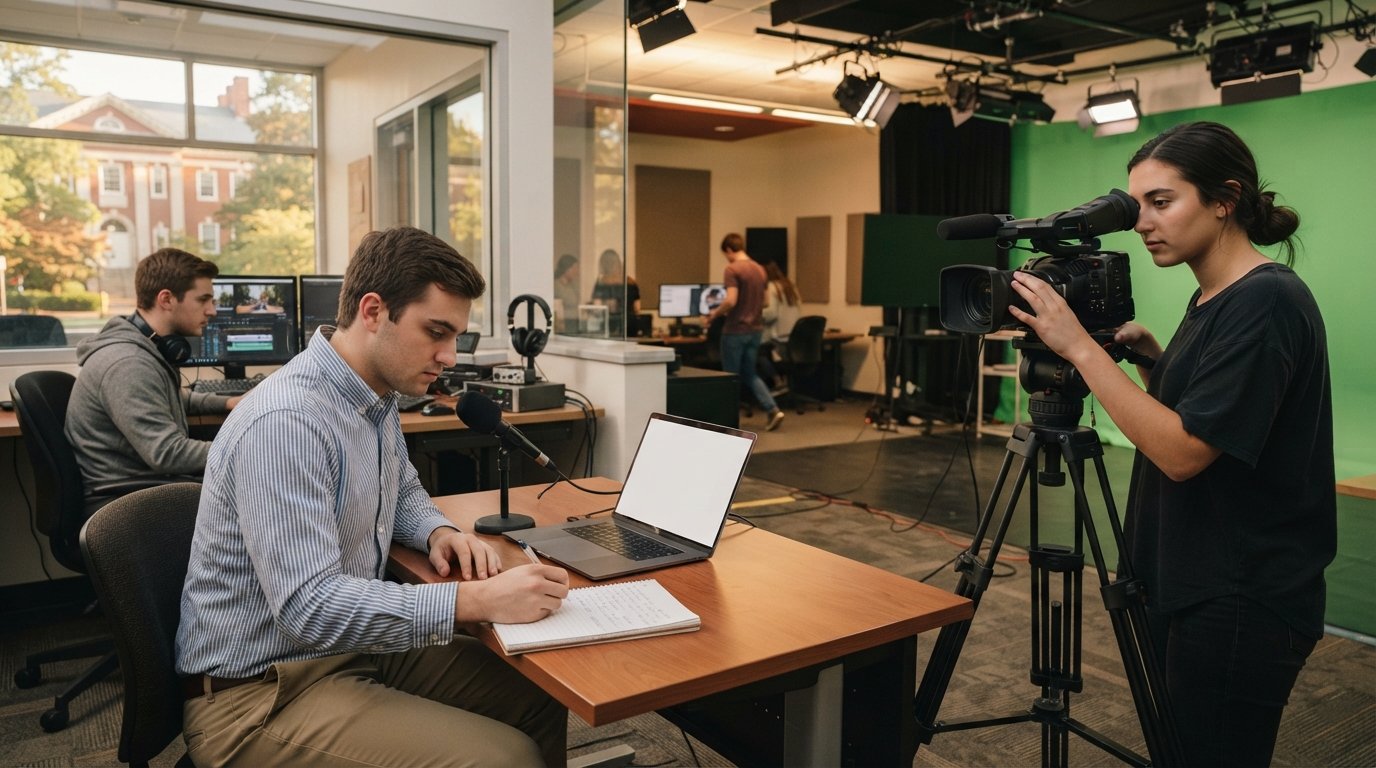
One practical advantage of the in-person format is access to equipment and mentorship. You learn to operate cameras, audio recorders, and editing software in a supervised environment, and you receive immediate feedback from instructors and peers. That kind of real-time critique is difficult to replicate fully online, which is why many students choose residential programs when their schedule and location allow it.
Admission Requirements and Application Steps
Admission to Campbellsville University is generally accessible, but the journalism program has specific expectations around writing ability and academic preparation. You will need to submit an application, official high school transcripts or equivalent, and standardized test scores if required. Transfer students should provide college transcripts for credit evaluation. Because requirements can change, always confirm current details directly with the admissions office before applying.
Here is a practical sequence to follow if you are preparing to apply:
- Request information from the university and confirm the journalism program's current admission criteria.
- Gather transcripts, test scores, and any writing samples or portfolios that strengthen your application.
- Complete the online application and pay the application fee if applicable.
- Apply for financial aid by submitting the FAFSA and explore institutional scholarships.
- Schedule a campus visit to tour media facilities and meet faculty in the communication department.
After acceptance, you will work with an academic advisor to map your four-year plan. This is also the moment to discuss transfer credits, minor options, and internship timing. Students who plan early often secure better internship placements because they can align course schedules with newsroom and studio availability.
Costs, Financial Aid, and Return on Investment
Tuition for a private university is higher than in-state public rates, so budgeting matters. Beyond tuition, factor in room and board, books, equipment, and travel for internships. Financial aid can reduce the net cost significantly through grants, scholarships, work-study, and federal loans. Campbellsville University also offers institutional aid, and journalism students may qualify for departmental scholarships based on merit or need.
To evaluate return on investment, compare projected starting salaries for journalists, broadcasters, and public relations specialists against your total borrowing. Entry-level journalism salaries vary widely by market and platform, and digital roles often pay differently than traditional print or broadcast positions. A useful exercise is to estimate your monthly loan payment after graduation and compare it to realistic starting pay in your target city.
If cost is a major concern, explore whether a hybrid path makes sense: complete general education courses at a lower-cost institution, then transfer into the journalism program for upper-division coursework. You can also review broader guidance on degree planning and financial aid through resources like CollegeDegrees.School, which covers college degree pathways and career planning for prospective students.
Careers and Salaries After Graduation
Graduates pursue roles as reporters, editors, broadcast journalists, multimedia producers, social media managers, and public relations specialists. Others move into corporate communications, nonprofit advocacy, or content marketing. The in-person training and internship experience give you clips, reels, and references that hiring managers expect to see.
Salary ranges depend on market size, platform, and experience. According to the U.S. Bureau of Labor Statistics, median pay for news analysts, reporters, and journalists is moderate compared with other bachelor's-level fields, but specialized skills in data journalism, video production, or public relations can increase earning potential. Many graduates also pursue freelance work or combine part-time reporting with communications roles to stabilize income early in their careers.
For a comparison point, some students consider adjacent fields such as health information management, where demand and salary trajectories differ. If you are exploring that alternative, this guide on a Bachelor of Health Information Management Degree Online explains program structure and career outcomes, which can help you weigh journalism against other bachelor's paths.
In-Person vs Online: Why Format Matters
The keyword phrase for this program, Journalism Bachelor's degree, usually 4 years In-person at Campbellsville University, highlights a key decision point: residential study versus online flexibility. In-person journalism education offers newsroom simulations, studio time, and face-to-face networking that can accelerate skill development. You also build relationships with local media professionals through guest lectures and internship pipelines.
Online programs can work well for adult learners who need schedule flexibility, but they may require you to arrange your own production equipment and internship placements. If you thrive in structured, hands-on environments and can relocate or commute, the residential format at Campbellsville may deliver stronger portfolio results. If you need to keep working full time, compare online journalism or communication degrees carefully before committing.
Consider these factors when choosing a format:
- Access to equipment, studios, and editing labs
- Internship placement support and local media partnerships
- Schedule flexibility and ability to work while studying
- Networking opportunities with faculty and alumni
- Total cost, including housing and relocation
Neither format is universally better. The right choice depends on your budget, location, learning style, and career timeline. A campus visit and a conversation with current students can clarify which environment will help you succeed.
Is This Program Right for You?
The Journalism Bachelor's degree, usually 4 years In-person at Campbellsville University, suits students who want immersive training, mentorship, and a faith-based liberal arts education. It is a strong fit if you plan to work in local news, broadcast, or public relations and you value hands-on learning. It is less ideal if you need a fully online schedule or if you are unwilling to relocate to Kentucky for the residential experience.
Before you apply, clarify your career target, estimate your budget, and confirm current program requirements with the university. Use the steps and comparisons above to make an informed decision, and explore accredited options that match your goals. With careful planning, this four-year in-person degree can launch a durable career in media and communications.