
Occupational Therapy Beyond a Bachelor's at A T Still University
Explore in-person occupational therapy study beyond a bachelor's degree at A T Still University of Health Sciences, including admissions, costs, and career outcomes.

What does it take to move from a bachelor's degree in kinesiology, psychology, or health science into a licensed career as an occupational therapist? For many adult learners, the answer runs through a graduate program that combines rigorous science with hands-on clinical training. At A T Still University of Health Sciences (ATSU), the residential occupational therapy pathway is built for students who want that depth of preparation in person, on campus, and alongside faculty who practice what they teach. This guide explains what the program offers, how it fits into the broader landscape of occupational therapy education, and how to decide whether an in-person graduate program is the right investment for your career.
Occupational therapy is a profession that changes lives. Therapists help children with developmental delays learn to dress themselves, support stroke survivors as they relearn daily routines, and work with injured workers to return to their jobs safely. That work requires more than a bachelor's degree. It requires a graduate-level education, supervised fieldwork, and a passing score on a national certification exam. If you are researching occupational therapy beyond a bachelor's degree, and specifically in-person study at A T Still University of Health Sciences, the details below will help you evaluate the program, the admissions path, and the return on your time and tuition.
Why Occupational Therapy Requires Education Beyond a Bachelor's Degree
The entry point into the occupational therapy profession has shifted over the past two decades. Today, the standard path is a Master of Occupational Therapy (MOT) or a Doctor of Occupational Therapy (OTD). A bachelor's degree alone does not qualify you to sit for the National Board for Certification in Occupational Therapy (NBCOT) exam, and it does not prepare you for state licensure. That is why programs like the one at A T Still University of Health Sciences are designed as graduate pathways, not undergraduate add-ons.
This structure exists for good reason. Occupational therapy draws on anatomy, neuroscience, kinesiology, psychology, and rehabilitation science. Practitioners must assess clients, design interventions, adapt environments, and document outcomes with precision. Graduate coursework builds that clinical reasoning layer by layer, and it does so in a supervised setting where mistakes become learning moments rather than risks to real clients.
For adult learners, this means planning early. Prerequisite courses in anatomy and physiology, statistics, and psychology are typically required before admission. Observation hours with a practicing occupational therapist are often expected as well. The stronger your undergraduate preparation, the smoother the transition into a graduate cohort.
It also helps to understand the broader universe of health professions education. Some students compare occupational therapy with related fields such as music therapy, which has its own graduate training requirements and clinical competencies. If you are exploring allied health careers more broadly, a resource like this guide to music therapy degree programs can help you compare how different therapy disciplines structure their graduate pathways.
Occupational Therapy at A T Still University of Health Sciences: Program Overview
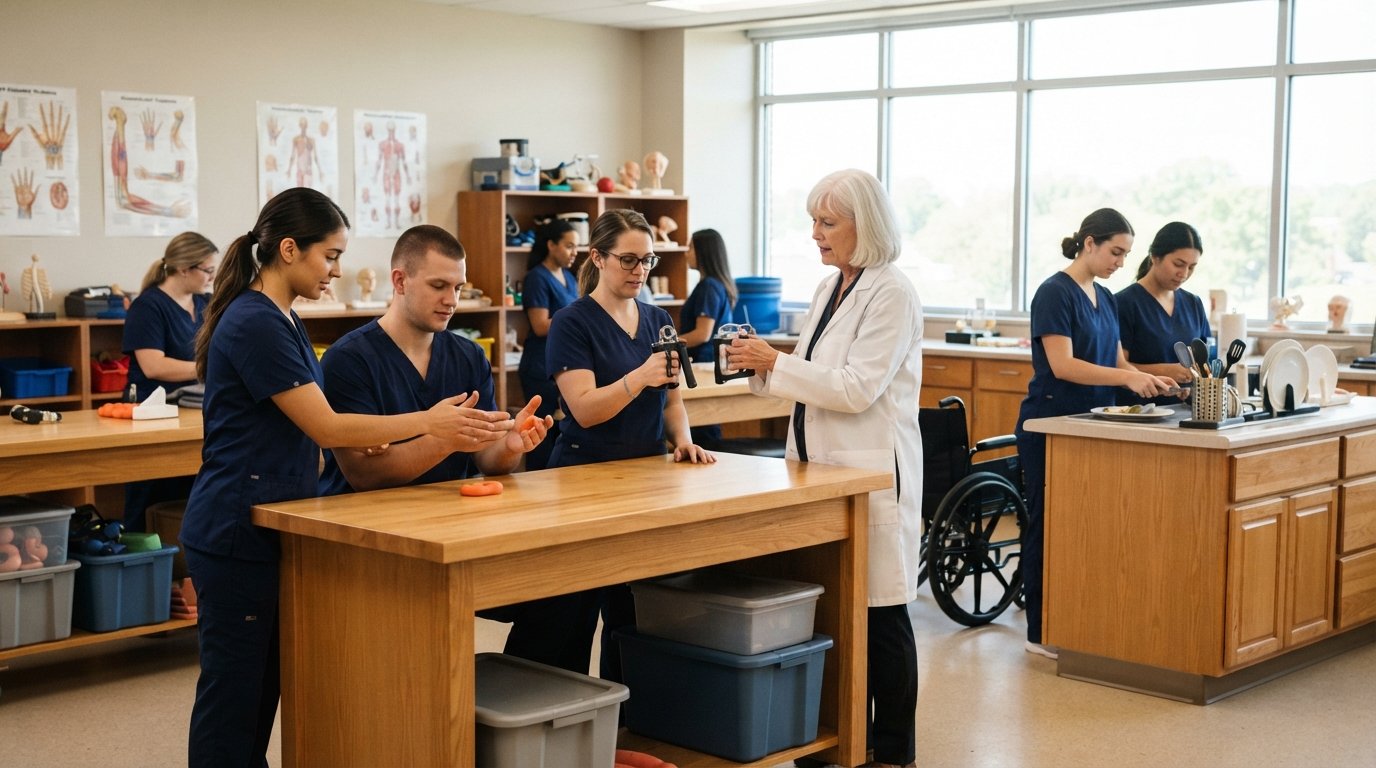
A T Still University of Health Sciences is a health sciences institution with a long history of educating clinicians. Its residential occupational therapy program is designed for students who want an in-person learning experience, with access to campus labs, simulation spaces, and faculty mentorship. The in-person format matters in a field where hands-on technique, client interaction, and interprofessional collaboration are central to practice.
Students in this type of program can expect a curriculum that blends foundational science with applied practice. Typical coursework includes anatomy and neuroscience, occupational performance across the lifespan, assessment and intervention planning, therapeutic modalities, and professional ethics. The program also includes Level I and Level II fieldwork placements, where students work directly with clients under supervision. Fieldwork is where classroom knowledge becomes clinical skill, and it is often the most formative part of the graduate experience.
Because A T Still University of Health Sciences is a health-focused institution, students may also benefit from interprofessional opportunities alongside students in other health professions. Learning to communicate with physical therapists, nurses, and physicians reflects the reality of clinical practice, where occupational therapists are part of a care team.
Prospective students should verify current program details directly with the university. Curriculum, credit hours, fieldwork requirements, and admission criteria can change, and the most reliable information comes from the program's official admissions office. The points below summarize the general structure you should expect and the questions worth asking.
- Degree type: Master of Occupational Therapy or Doctor of Occupational Therapy, depending on the program track available.
- Format: In-person, residential study with campus-based labs and supervised fieldwork.
- Prerequisites: Undergraduate coursework in anatomy, physiology, statistics, and related sciences, plus observation hours.
- Clinical training: Level I and Level II fieldwork placements in varied practice settings.
- Outcome: Eligibility to sit for the NBCOT exam and pursue state licensure.
Each of these elements deserves careful attention. Fieldwork placement sites, for example, can shape your early career network. A program with strong clinical partnerships may offer placements in schools, hospitals, rehabilitation centers, or community organizations. Ask about placement variety and support during the fieldwork process.
In-Person Learning: What the Campus Experience Adds
Online education has expanded access to many graduate fields, but occupational therapy is one of those disciplines where in-person learning carries distinct advantages. Practitioners use their hands, their bodies, and their observation skills to assess and treat clients. Learning those skills requires practice with real equipment, real peers, and real-time feedback.
In-person study at A T Still University of Health Sciences means access to dedicated lab spaces where students practice transfers, mobility techniques, and adaptive equipment use. It means face-to-face time with faculty who can correct technique in the moment. It also means cohort relationships that often carry into professional life. Occupational therapy is a collaborative profession, and the habits of collaboration form best when students learn side by side.
That said, in-person study requires logistical planning. Adult learners may need to relocate, reduce work hours, or arrange family care during the program. Financial aid planning becomes especially important when a program limits outside employment. This is where early research pays off. Scholarship databases such as Scholarship.Education can help prospective graduate students identify funding opportunities before committing to a program, and the site covers awards for non-traditional students as well as traditional applicants.
Admissions and Prerequisites: Building a Competitive Application
Admission to a graduate occupational therapy program is competitive, and the strongest applications show preparation well before the application deadline. Most programs expect a bachelor's degree from an accredited institution, a minimum GPA, completion of specific prerequisite courses, and evidence of exposure to the profession through observation or volunteer hours. Letters of recommendation and a personal statement round out the picture.
Applicants should treat prerequisite planning as a multi-month project. Anatomy and physiology sequences often fill quickly at community colleges, and some courses require labs that are only offered in specific terms. Mapping out a timeline can prevent a last-minute scramble. Observation hours should be documented carefully, with supervisor signatures and dates, because programs often verify them.
The personal statement deserves genuine effort. Admissions committees read many essays, and the ones that stand out explain why occupational therapy specifically, not just health care in general. A strong essay connects personal experience to the profession's core values: helping people participate in the activities that matter to them.
- Complete or verify all prerequisite coursework and confirm grades meet program thresholds.
- Accumulate and document observation hours with a licensed occupational therapist.
- Request letters of recommendation from professors or supervisors who know your work.
- Draft and revise a personal statement that connects your experience to occupational therapy practice.
- Submit the application early and confirm receipt of every required document.
Applicants should also plan for interviews if the program requires them. Interview preparation is not about memorizing answers; it is about practicing clear, reflective communication about your motivations and your understanding of the field.
Costs, Financial Aid, and Return on Investment
Graduate study in occupational therapy represents a significant financial commitment. Tuition varies by program and residency status, and students should budget for fees, books, equipment, fieldwork travel, and living expenses. The total cost of attendance matters more than the sticker tuition price, so request a complete cost breakdown from the program.
Financial aid options typically include federal student loans, institutional scholarships, graduate assistantships, and external awards. Employer tuition assistance is sometimes available for working professionals, though in-person programs may limit full-time employment. Veterans and military families should explore benefits specific to their service.
Return on investment deserves an honest look. Occupational therapy salaries vary by setting, geography, and experience, but the profession offers stable demand tied to aging populations and growing recognition of rehabilitation services. Students should compare projected earnings with total borrowing and plan repayment realistically. A conversation with a financial aid counselor, combined with research into salary data for your target region, provides a clearer picture than national averages alone.
It is also worth comparing the cost of in-person study with online alternatives in other fields. Some students reduce total costs by completing prerequisite coursework online before entering a residential program. The key is to verify that online courses are accepted by the program you plan to attend.
Career Outcomes and Professional Pathways
Graduates of occupational therapy programs enter a profession with diverse practice settings. Hospitals, outpatient clinics, schools, skilled nursing facilities, home health agencies, and community organizations all employ occupational therapists. Some therapists specialize in pediatrics, hand therapy, mental health, or assistive technology. Others move into management, education, or research after gaining clinical experience.
Licensure is required in every state, and the process typically includes passing the NBCOT exam and meeting state-specific requirements. Graduates should begin the licensure process early, because timelines can affect when they can start working. Programs often provide guidance on exam preparation and application steps.
Career advancement in occupational therapy can take several forms. Clinical specialization, leadership roles, teaching, and doctoral study are all viable paths. An OTD, for example, can open doors to advanced practice, academia, and program development. Professionals who plan to move into education or research may also explore doctoral programs in related health fields; our guide to accredited online degree programs can help you compare graduate options across disciplines.
How to Decide If This Program Fits Your Goals
The right program depends on your circumstances, your learning style, and your career goals. In-person study at A T Still University of Health Sciences may be ideal for students who value hands-on learning, close faculty mentorship, and a cohort model. It may be less practical for students who cannot relocate or reduce work hours.
Prospective students should visit campus if possible, speak with current students and alumni, and ask detailed questions about fieldwork placement, licensure exam pass rates, and support services. Comparing several programs side by side, using the same criteria for each, leads to better decisions than relying on rankings alone.
Finally, keep the profession's purpose in view. Occupational therapy is about helping people do the things they need and want to do. If that mission resonates with you, the investment of time and tuition in a graduate program is more than a credential; it is preparation for meaningful work. Take the next step by requesting information from the program, confirming prerequisites, and building a financial plan that makes the journey sustainable.