
Phlebotomy Certificate in 12 Weeks at Coffeyville
Earn your Phlebotomy Technician/Phlebotomist Certificate in less than 12 weeks in person at Coffeyville Community College and start a fast-growing healthcare career.

By Amelia Brown
Healthcare careers offer stability, purpose, and a clear path forward, but many require years of study before you can earn a paycheck. If you are looking for a role that lets you enter the clinical world quickly, phlebotomy stands out as one of the most accessible options. The Phlebotomy Technician/Phlebotomist Certificate, less than 12 weeks In-person at Coffeyville Community College, is designed for people who want hands-on training without a long-term academic commitment. In just a few months, you can gain the skills to draw blood, interact with patients, and work alongside medical professionals in hospitals, clinics, and laboratories.
This program is not just about learning how to insert a needle. It prepares you for a career that requires precision, empathy, and attention to safety protocols. Whether you are a recent high school graduate, a career changer, or someone returning to the workforce, this certificate can open doors to entry-level positions in a growing field. The Bureau of Labor Statistics projects that phlebotomist employment will grow faster than the average for all occupations, driven by an aging population and increased demand for diagnostic testing. By choosing Coffeyville Community College, you are investing in a credential that is recognized by employers and can be completed in under three months.
Why Choose a Fast-Track Phlebotomy Program?
Time is often the biggest barrier when adults consider going back to school. Balancing work, family, and other responsibilities makes it hard to commit to a two-year or four-year degree. A certificate program that lasts less than 12 weeks solves this problem by offering a focused curriculum that covers only what you need to know for entry-level phlebotomy positions. You are not spending semesters on general education requirements; instead, you are learning venipuncture, capillary sticks, specimen handling, and patient communication from day one.
Beyond the speed, a short-term certificate offers financial advantages. Tuition is lower than a full degree, and you can start earning sooner. The return on investment is clear: after completing the program, you can apply for roles that pay a median hourly wage that is competitive for an entry-level healthcare position. Many graduates use this certificate as a stepping stone to further education in nursing, medical assisting, or laboratory science. The skills you learn are not dead ends; they are building blocks for a larger healthcare career.
For those who are unsure about committing to a long academic path, this certificate provides a low-risk way to test the waters. You will discover if you enjoy patient interaction and clinical environments before investing in a more expensive degree. And because the program is in-person, you get immediate feedback from instructors and real practice on training arms and, eventually, on fellow students. This hands-on approach builds confidence quickly, which is essential when you start working with real patients who may be nervous about needles.
What You Will Learn in the Coffeyville Program
The curriculum for the Phlebotomy Technician/Phlebotomist Certificate, less than 12 weeks In-person at Coffeyville Community College, is designed to balance theory with practice. You will start with the basics of anatomy and physiology, specifically the circulatory system, because you need to understand what is happening beneath the skin to draw blood effectively. Then you will move into the technical skills: choosing the right vein, applying a tourniquet, performing venipuncture, and collecting capillary specimens from fingers or heels.
Safety is a major component of the training. You will learn about standard precautions, personal protective equipment, and how to prevent needlestick injuries. Infection control is critical in any healthcare setting, and employers expect phlebotomists to follow strict protocols. The program also covers proper specimen labeling, handling, and transportation, because errors in these areas can lead to misdiagnosis or rejected samples. You will learn how to verify patient identity, which is a simple step that prevents serious mistakes.
Communication skills are another key part of the curriculum. Drawing blood can be stressful for patients, especially children, the elderly, or those with a fear of needles. You will practice explaining procedures, calming anxious patients, and responding to adverse reactions like fainting or nausea. These soft skills are often what separate a good phlebotomist from a great one, and they are emphasized throughout the course.
Hands-On Clinical Practice
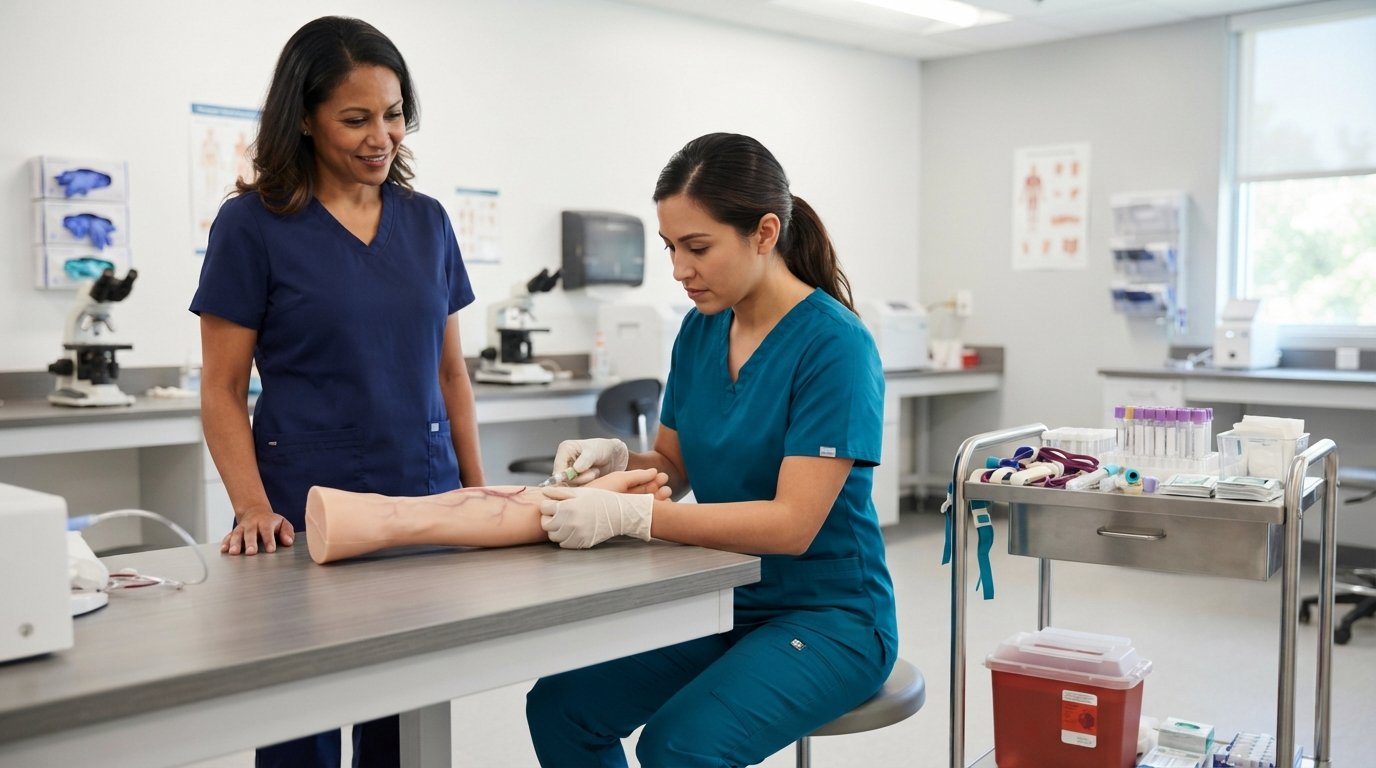
Classroom lectures are important, but phlebotomy is a skill that must be practiced. Coffeyville Community College provides a laboratory setting where you can practice on simulation equipment before moving on to live draws. You will perform multiple successful venipunctures on classmates under instructor supervision, which is a requirement for graduation. This practical experience ensures you are not just book-smart but also ready to handle the physical demands of the job.
The program also prepares you for the certification exam. While Kansas does not require a state license for phlebotomists, most employers prefer or require a national credential. Completing this certificate makes you eligible to sit for exams such as the Certified Phlebotomy Technician (CPT) through the National Healthcareer Association or the Phlebotomy Technician (PBT) through the American Society for Clinical Pathology. Passing one of these exams can significantly boost your resume and job prospects.
Career Paths and Job Outlook
Once you earn your certificate, you can start applying for positions in a variety of settings. Hospitals are the largest employer of phlebotomists, with many working in outpatient labs or emergency departments. Diagnostic laboratories, blood donation centers, and physician offices also hire phlebotomists regularly. Some graduates find work in research facilities or insurance companies that require in-house blood draws for policyholders.
The job outlook is strong. The U.S. Bureau of Labor Statistics projects a faster-than-average growth rate for phlebotomists over the next decade. As the population ages, more diagnostic tests are ordered, which means more blood draws. In addition, advances in laboratory technology have made it possible to run more tests on smaller samples, but the human element of drawing the blood is still essential. Automation cannot replace the need for a skilled professional who can find a vein on a difficult patient and ensure the sample is viable.
Starting salaries vary by region and employer, but entry-level phlebotomists can expect to earn a wage that is above minimum wage, with opportunities for overtime in hospitals. Experienced phlebotomists can advance to lead phlebotomist, donor center supervisor, or laboratory assistant roles. Others choose to continue their education in nursing or medical technology, using their phlebotomy experience as a foundation. The certificate is not a ceiling; it is a doorway.
For working adults, the schedule of the in-person program at Coffeyville is designed with flexibility in mind. Classes may be offered during the day or evening, depending on the term. However, because the program is compressed into less than 12 weeks, attendance is mandatory and the pace is fast. You should be prepared to dedicate several hours each week to class and practice sessions. This intensity is what makes the program effective, but it also requires commitment.
How to Enroll and What to Expect
Admission to the program is straightforward. You must have a high school diploma or GED. Some programs require a background check and proof of immunizations before you can participate in clinical practice. Coffeyville Community College will provide a list of required documents when you apply. It is a good idea to apply early because class sizes are limited to ensure each student gets enough individual attention from instructors.
Financial aid is available for eligible students. You may qualify for federal grants or loans, and the college can help you navigate the application process. In addition, some students receive funding through workforce development programs, especially if they are unemployed or underemployed. The cost of the program is a fraction of what you would spend on a two-year degree, and the potential return in terms of salary and job security makes it a smart investment.
Before you start, you should review the program requirements and prepare for the fast pace. This is not a self-paced online course; it is an intensive in-person experience. You will be on your feet, practicing skills, and interacting with classmates. If you are someone who learns best by doing, this format will suit you well. The instructors at Coffeyville are experienced healthcare professionals who can offer real-world insights and mentoring.
To support your career planning, you may also want to explore other healthcare training options. If you are considering a broader role in patient care, our guide on business management degree community college online might offer insight into administrative pathways, though the focus here is on clinical skills.
Why In-Person Training Matters for Phlebotomy
Some aspects of phlebotomy can be learned online, but the physical skill of drawing blood cannot. You need to develop muscle memory for holding the needle, adjusting the angle, and applying pressure after the draw. You also need to practice on real people to learn how to handle different vein types, skin textures, and patient reactions. An in-person program at Coffeyville provides a safe environment to make mistakes and learn from them under the watchful eye of an instructor.
Another benefit of in-person training is networking. You will meet classmates who are also starting their healthcare careers, and you will interact with instructors who have contacts in local hospitals and clinics. Many phlebotomy jobs are found through word of mouth, and the connections you make during the program can lead to job offers. The college may also have partnerships with local healthcare facilities that offer clinical rotations or job placement assistance.
In-person training also holds you accountable. When you have a scheduled class and a lab session, you are more likely to stay on track than if you are watching videos at home. The structure of the program ensures that you are practicing consistently, which is essential for building competence in a short amount of time. You will leave the program not just with a certificate, but with a portfolio of successful blood draws that you can discuss in job interviews.
For those who are considering a career in healthcare, exploring broader educational resources can be helpful. Websites like CollegeDegrees.School offer guidance on various degree levels and career planning, which can be useful as you think about your long-term path. However, the immediate step is to gain the hands-on skills that this certificate provides.
Is This Certificate Right for You?
The Phlebotomy Technician/Phlebotomist Certificate, less than 12 weeks In-person at Coffeyville Community College, is ideal for individuals who are:
- Looking for a quick entry into healthcare without a multi-year commitment.
- Comfortable working with people and able to remain calm in stressful situations.
- Detail-oriented and able to follow strict safety protocols.
- Willing to work flexible hours, as many healthcare facilities operate 24/7.
- Interested in building a foundation for further medical education.
If you are patient and have a steady hand, you can succeed in phlebotomy. The program will teach you the technical skills, but you need to bring a professional attitude and a willingness to learn. You should also be comfortable with the sight of blood, as that is a daily part of the job. If you are unsure whether phlebotomy is the right fit, you might consider shadowing a phlebotomist at a local clinic or hospital to see the work firsthand.
The short duration of the program is a double-edged sword. It means you can start your career quickly, but it also means the coursework is intense. You will need to study, practice, and attend every session. If you have other major obligations, such as a full-time job or childcare, you must plan accordingly. Some students reduce their work hours during the 12 weeks to focus on the program. The investment of time is small compared to the long-term benefit of a healthcare career.
In summary, this certificate is a practical, affordable, and fast way to become a certified phlebotomist. Coffeyville Community College offers a rigorous in-person program that emphasizes both technical proficiency and patient interaction. Graduates leave with the confidence to perform blood draws safely and professionally, ready to fill the growing demand in healthcare.
If you are ready to take the next step, contact the admissions office at Coffeyville Community College to learn about upcoming start dates and application deadlines. The sooner you enroll, the sooner you can be working in a rewarding healthcare role. Do not let another year pass while you wonder about a career change. This 12-week program is your fast track to a new profession.