
Physical Sciences Associate Degree at Estrella Mountain CC
Explore the Physical Sciences, General Associate's degree at Estrella Mountain Community College: a two-year, in-person program designed for seamless university transfer and science careers.
By James Morgan
For students drawn to chemistry, physics, geology, or astronomy, the journey often begins with a two-year foundation. At Estrella Mountain Community College (EMCC) in Avondale, Arizona, the Physical Sciences, General Associate's degree offers exactly that: a structured, in-person pathway designed for transfer and future success. This program is not just a collection of science courses. It is a deliberate sequence of learning that builds critical thinking, laboratory skill, and quantitative reasoning. For adult learners, career changers, and working professionals, this degree can serve as a strategic first step toward a four-year degree or entry-level technical work. This guide explores the program's structure, its real-world value, and how it fits into a broader educational plan.
What Is the Physical Sciences, General Associate's Degree at EMCC?
The Physical Sciences, General Associate's degree at Estrella Mountain Community College is a two-year program that introduces students to the core disciplines of the physical sciences. It is designed around the Associate of Science (AS) framework, which emphasizes mathematics, laboratory science, and general education. Unlike specialized tracks in engineering or health sciences, this generalist path allows students to sample multiple fields, from classical mechanics to organic chemistry, before committing to a specific major at a university.
The program typically requires about 60 credit hours, which full-time students can complete in two years. Because it is an in-person offering, students benefit from direct interaction with faculty, hands-on laboratory work, and access to campus resources like tutoring centers and study groups. This format is particularly valuable for subjects that require physical experimentation, such as titration in chemistry or mineral identification in geology. For those who thrive in structured, collaborative environments, the campus experience at EMCC provides a supportive foundation.
One of the most important features of this degree is its transferability. EMCC has articulation agreements with Arizona universities, including Arizona State University, the University of Arizona, and Northern Arizona University. This means that courses taken under this associate degree are mapped to specific bachelor's degree requirements, reducing the risk of lost credits. For students planning to pursue a bachelor's in chemistry, physics, earth science, or a related field, this degree is a practical and cost-effective starting point.
Why Choose an In-Person Program at Estrella Mountain Community College?
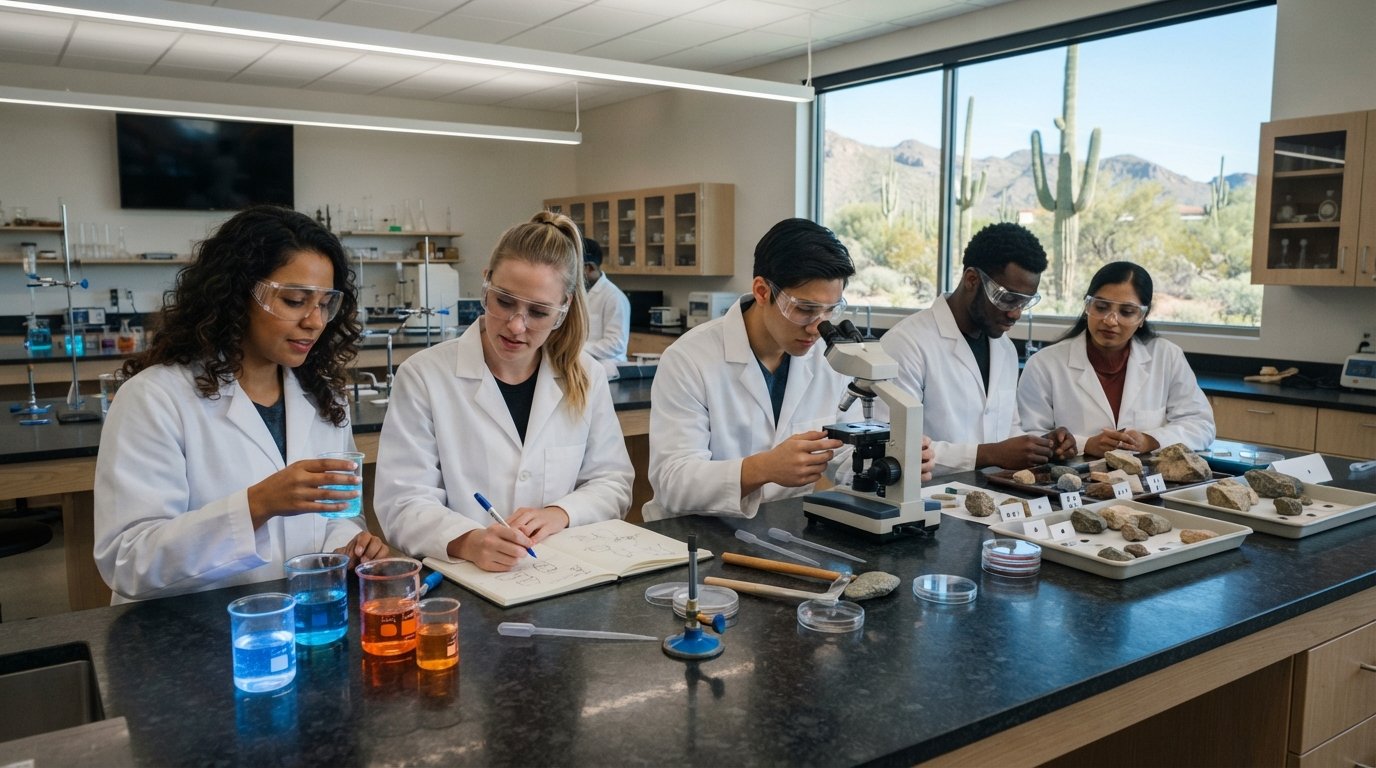
In an era of expanding online education, the choice to attend classes in person might seem counterintuitive. However, for physical sciences, the in-person format offers distinct advantages that directly impact learning outcomes. Laboratories are the heart of scientific inquiry, and EMCC's on-campus labs are equipped with the instruments and materials that online simulations cannot fully replicate. Students learn to handle glassware, calibrate sensors, and follow safety protocols, skills that are essential for upper-division coursework and employment in research settings.
Beyond the lab, in-person learning fosters a sense of community and accountability. Regular class attendance and face-to-face interaction with professors can be especially beneficial for students who need structure or who are returning to academics after a break. Study groups often form organically, and peer support becomes a resource during challenging courses like calculus-based physics. Additionally, EMCC's campus provides access to academic advising, career counseling, and transfer workshops, all of which are easier to navigate when you are physically present.
For adult learners and working professionals, the schedule is a key consideration. Many EMCC physical science courses are offered in the late afternoon or evening, accommodating students who work during the day. While the program is not fully online, the in-person requirement is balanced by flexible timing. This blend of rigor and adaptability makes the program a viable option for those balancing multiple responsibilities.
Core Curriculum and Learning Outcomes
The curriculum for the Physical Sciences, General Associate's degree at EMCC is built around a sequence of integrated courses. Students begin with foundational mathematics, typically through calculus, because physics and chemistry rely heavily on algebraic and trigonometric concepts. From there, the program introduces the major branches of physical science, allowing students to explore each before specializing.
Typical course requirements include:
- General Chemistry I and II: Covers atomic structure, chemical bonding, stoichiometry, and thermodynamics, with accompanying laboratory work.
- Physics I and II: Focuses on mechanics, electricity, magnetism, and waves, using algebra and calculus to solve real-world problems.
- Geology or Astronomy: Offers an introduction to earth systems or celestial phenomena, fulfilling the breadth requirement in physical science.
- Calculus I and II: Provides the mathematical tools necessary for advanced science coursework.
- General Education: Includes English composition, humanities, and social sciences, ensuring a well-rounded education that supports communication and critical thinking.
These courses are not isolated; they are sequenced so that concepts build on one another. For example, thermodynamics in chemistry is reinforced by similar principles in physics. The laboratory components are integrated into each science course, giving students practical experience with data collection, error analysis, and scientific writing. By the end of the program, graduates should be able to apply the scientific method, interpret quantitative data, and communicate technical information effectively.
While the degree is general by design, students can often choose electives that align with their intended transfer major. For instance, someone planning to major in geology might take an extra earth science course, while a future physicist might add a third semester of calculus. Advisors at EMCC help students select these electives based on their university's requirements, ensuring a smooth transition.
Career Pathways and Transfer Opportunities
Graduates of the Physical Sciences, General Associate's degree have two primary paths: transfer to a four-year institution or entry into the workforce. The most common route is transfer, as the associate degree is designed to satisfy lower-division requirements for a bachelor's degree in a physical science or a related field. At a university, students can specialize in areas like chemistry, physics, environmental science, or materials science, opening doors to careers in research, education, and industry.
For those who choose to enter the workforce immediately, the associate degree provides foundational skills for entry-level positions in laboratories, quality control, environmental monitoring, and technical support. Job titles might include laboratory assistant, research technician, or field sampler. While these positions often require additional on-the-job training, the degree demonstrates a solid understanding of scientific principles, which is attractive to employers.
It is important to note that some careers, such as certified engineering technician or certain healthcare roles, may require additional certification or licensing. Students are advised to research their target career early and consult with EMCC's career services to understand the specific requirements. For those considering a bachelor's degree, the transfer process is well supported. EMCC's partnership with Arizona universities means that students can often complete their junior and senior years without repeating courses, saving both time and money.
The return on investment for this degree is significant. Community college tuition is substantially lower than university tuition, and completing the first two years at EMCC can save thousands of dollars. Furthermore, many students qualify for financial aid, scholarships, or employer tuition reimbursement, making the program even more accessible. To explore how this degree compares to other affordable science pathways, you might review our analysis of cheapest online computer science degrees for 2026, which highlights similar cost-saving strategies in a different field.
Admission Requirements and Enrollment Process
Getting started at Estrella Mountain Community College is straightforward. The college has an open admissions policy, meaning that any student with a high school diploma or GED can enroll. There are no competitive entry requirements for the Physical Sciences, General program, which makes it accessible to a wide range of students, including those who may not have excelled in science previously.
Prospective students should complete the following steps:
- Apply for admission: Complete the online application through the Maricopa Community Colleges system, of which EMCC is a part. The application is free and takes about 15 minutes.
- Complete placement testing: Unless you have qualifying ACT, SAT, or prior college credit, you will need to take a placement test to determine your starting level in math and English. This ensures you are enrolled in courses that match your current skills.
- Meet with an academic advisor: An advisor will help you select your first semester courses, review your transfer goals, and create a semester-by-semester plan. This is an essential step to avoid taking unnecessary classes.
- Register for classes and pay tuition: Once your plan is set, you can register for courses through the student portal. Payment plans and financial aid are available for those who qualify.
International students on F-1 visas must follow additional steps, including providing proof of English proficiency and financial support. EMCC's international student office can guide you through these requirements. For all students, it is advisable to apply early, especially for fall semesters, to secure a spot in high-demand courses like general chemistry.
Costs, Financial Aid, and Scholarships
The cost of the Physical Sciences, General Associate's degree at EMCC is one of its most attractive features. For in-state students, tuition is approximately $85 per credit hour, which translates to about $2,550 per year for a full-time load of 30 credits. Out-of-state students pay higher rates, but many can establish Arizona residency after one year, significantly reducing costs. Additionally, the Maricopa Community Colleges system offers a tuition guarantee for first-time, in-state students, locking in the same rate for up to three years.
Beyond tuition, students should budget for textbooks, lab fees, and supplies, which can add $500 to $1,000 per semester. However, many courses use open educational resources (OER) or low-cost materials, and financial aid can cover these expenses. The Free Application for Federal Student Aid (FAFSA) is the first step for most students, as it determines eligibility for federal grants, loans, and work-study programs. Arizona residents may also qualify for state grants, such as the Arizona Leveraging Educational Assistance Partnership (LEAP) program.
EMCC also offers several scholarships specifically for science students. The Maricopa Foundation and the college's own scholarship portal list opportunities based on academic merit, financial need, and field of study. For example, the STEM Scholarship supports students pursuing degrees in science, technology, engineering, or math, providing up to $2,000 per year. Students are encouraged to apply early, as deadlines often fall months before the semester begins.
For working adults, employer tuition assistance is another avenue. Many companies offer reimbursement for job-related education, and a physical sciences degree can be positioned as a way to enhance technical skills. Even if your current role does not require a degree, the critical thinking and analytical abilities gained from this program are valuable assets in many industries.
Student Life and Support at EMCC
Success in a rigorous science program depends on more than just coursework. Estrella Mountain Community College offers a range of support services designed to help students thrive. The Academic Success Center provides free tutoring in math, chemistry, and physics, both drop-in and by appointment. For students who need additional help, the center also offers study skills workshops and peer-led team learning sessions.
The college's science department hosts a chapter of the American Chemical Society (ACS) student affiliate, which organizes guest lectures, industry tours, and networking events. Participation in such clubs can enhance your resume and connect you with professionals in the field. Similarly, the STEM club offers social events and volunteer opportunities, fostering a community of like-minded students.
For those balancing family and work, EMCC provides a Veterans Center, a Women's Resource Center, and a food pantry, all of which help remove barriers to success. The college also has a robust online portal for grades, assignments, and communication, so you can stay organized even when you are not on campus. Advisors are available to help with academic planning, but they also offer career counseling, helping you connect your studies to real-world opportunities.
Comparing EMCC's Program to Other Options
When evaluating the Physical Sciences, General Associate's degree at EMCC, it is helpful to consider alternatives. Online programs offer flexibility, but they lack the hands-on laboratory experience that is critical for physical sciences. Some universities offer accelerated or hybrid programs, but these often come with higher tuition. The in-person format at EMCC strikes a balance between cost, quality, and practical training.
Another option is to pursue a specialized associate degree, such as an Associate of Applied Science (AAS) in a technical field like instrumentation or environmental technology. These programs prepare students for immediate employment, but they are often less transferable to a four-year degree. The general AS degree at EMCC is designed for transfer, making it a more strategic choice for students who plan to continue their education.
For a broader perspective on how different science pathways compare in terms of cost and outcomes, you might consider resources like CollegeDegrees.School, which offers detailed guides on various degree types and career planning. That platform can help you contextualize the EMCC program within the larger landscape of higher education, ensuring you make an informed decision.
Planning Your Two Years at EMCC
To maximize the value of the Physical Sciences, General Associate's degree, students should approach it with a clear plan. In the first year, focus on completing general education requirements and foundational math and science courses. For example, you might take General Chemistry I in the fall and General Chemistry II in the spring, alongside Calculus I and English composition. This builds a strong base while allowing you to adjust to college-level expectations.
In the second year, shift toward more advanced courses, such as Physics I and II, and begin taking electives that align with your transfer major. If you are considering a specific university, research its course equivalency guides early. EMCC's transfer services can help you map out which courses will satisfy your bachelor's degree requirements, avoiding unnecessary duplicates. It is also wise to visit the universities you are considering, attend transfer fairs, and speak with departmental advisors to ensure a seamless transition.
Throughout the program, take advantage of office hours and build relationships with your professors. Their letters of recommendation can be invaluable when you apply for university admission or scholarships. Additionally, consider engaging in undergraduate research, even at the community college level. EMCC occasionally offers research-based independent study courses, which can provide a taste of scientific inquiry and strengthen your application.
The Physical Sciences, General Associate's degree at Estrella Mountain Community College is more than a stepping stone; it is a solid educational foundation that opens doors to further study and meaningful careers. With its in-person instruction, dedicated faculty, and clear transfer pathways, this program offers a practical and affordable route into the world of physical science. For students who are ready to commit to a two-year journey of discovery, EMCC provides the tools, support, and community needed to succeed. Whether you aim to become a chemist, a physicist, or a science educator, this degree is a wise first step. Take the time to visit the campus, talk to an advisor, and envision your future as part of the scientific community. The path starts here, and the possibilities are vast.