
Physics Beyond a Bachelor's at Boston College
Explore advanced physics study beyond a bachelor's degree in person at Boston College. Call 8772187081 for guidance on graduate physics pathways.

By Patrick Dawson
Boston College offers a distinctive path for physics students who want to move beyond the bachelor's degree while staying on campus and working closely with faculty. The Department of Physics provides graduate study that leads to the Master of Science and the Doctor of Philosophy, and both are delivered in person on the Chestnut Hill campus. For adult learners and career changers who are weighing whether to pursue advanced physics, this article explains what the programs involve, how they compare, and what you should consider before applying.
Advanced physics is not simply more of the same material you covered as an undergraduate. It is a shift toward research, original problem solving, and deep specialization. At Boston College, that shift happens in a department known for strong work in condensed matter physics, quantum information, and astrophysics, among other areas. If you are exploring how to choose the right college degree programs for your goals, understanding the difference between a master's and a doctorate in physics is a useful starting point.
What Advanced Physics Study Looks Like at Boston College
Boston College is a private Jesuit research university in Chestnut Hill, Massachusetts, just outside Boston. Its physics department is small enough that graduate students get personal attention, yet active enough to support serious research. Faculty work in areas such as condensed matter and materials physics, quantum optics, particle physics, and astrophysics and cosmology. Graduate students typically join a research group and contribute to publishable work, which is a major difference from the undergraduate experience.
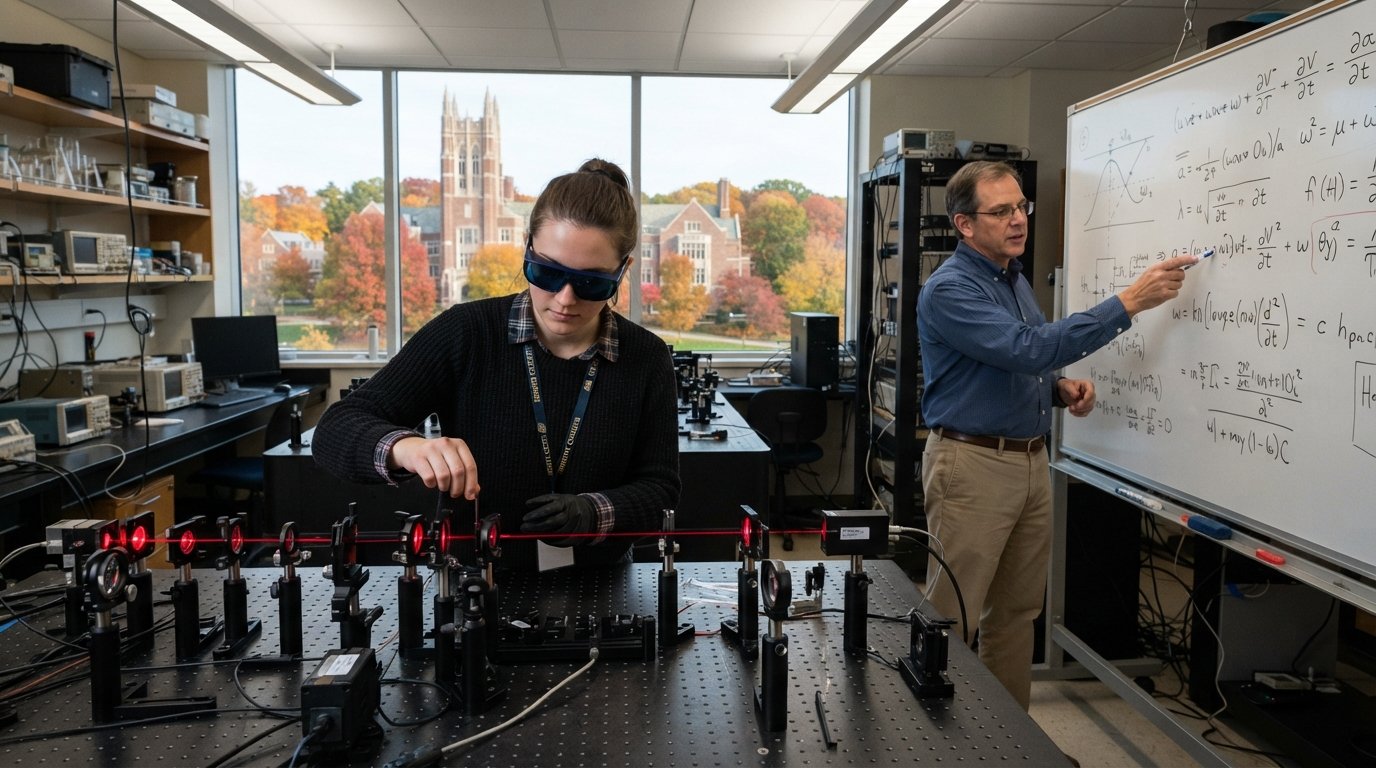
Because the programs are in person, students have regular access to laboratories, equipment, and faculty offices. That matters in physics, where hands-on experimentation and face-to-face mentorship often shape the quality of your training. The department also benefits from Boston's dense academic and technology ecosystem, which includes nearby universities, hospitals, and research institutes where collaboration and internships can develop.
The master's program is generally a two-year course of study for full-time students, though part-time attendance may be possible depending on research and course scheduling. The doctoral program typically takes five to six years and culminates in a dissertation based on original research. Admission is competitive, and applicants usually need a strong undergraduate background in physics or a closely related field, including coursework in mechanics, electromagnetism, quantum mechanics, and mathematical methods.
Master of Science Versus Doctor of Philosophy: Which Path Fits You
The two graduate degrees serve different purposes, and choosing between them depends on your career goals, timeline, and appetite for research. A master's degree can deepen your knowledge, improve your credentials for technical jobs, or prepare you for further study. A doctorate is the standard credential for research careers in academia, national laboratories, and many industrial research and development roles.
Neither path is inherently better. What matters is alignment with the work you want to do. A student who wants to teach at a community college, work as a data scientist, or support engineering teams may find a master's sufficient and faster. A student who wants to lead research programs, teach at a university, or work at the frontier of a specialized field will usually need the doctorate.
Here are the main differences to weigh:
- Time to completion: A master's often takes about two years, while a doctorate commonly takes five to six years.
- Research expectation: Master's students complete a thesis or a substantial project; doctoral students produce original research that advances the field.
- Career outcomes: Master's graduates move into industry, education, or further study; doctoral graduates pursue research, academia, or senior technical roles.
- Funding: Doctoral students in physics frequently receive teaching or research assistantships that cover tuition and provide a stipend; master's students are more likely to pay tuition, though some support may be available.
- Admission profile: Doctoral admission is more selective and expects demonstrated research potential; master's admission is still competitive but somewhat broader.
At Boston College, both degrees are awarded by the same department, so the faculty and facilities overlap. That means a master's student can often work alongside doctoral students and benefit from the same research culture. If you are unsure, it is reasonable to apply to the master's program first and decide later whether to continue toward a doctorate, provided you perform well and secure a faculty advisor.
Admission Requirements and Application Steps
Admission to Boston College graduate physics programs is handled through the university's graduate school, with review by the physics department. Requirements are typical for research-oriented physics programs, but you should always confirm current details on the official Boston College website because policies can change.
Most applicants submit an online application, transcripts from all colleges attended, a statement of purpose, letters of recommendation, and scores from the GRE or a similar exam if required. International applicants may also need to demonstrate English proficiency. A strong personal statement explains why you want to study physics at the graduate level, which research areas interest you, and how your background prepares you for the work.
You can think of the application process as a sequence:
- Confirm the specific program and deadline on the Boston College physics department website.
- Gather transcripts, test scores, and recommendation letters well before the deadline.
- Write a statement of purpose that connects your goals to faculty research areas.
- Reach out to potential faculty advisors if the department encourages it.
- Submit the application and follow up on any missing materials.
Because funding and research openings vary, contacting faculty early can help you understand whether your interests match available projects. It also signals genuine motivation, which matters in a small department. For broader guidance on comparing programs and understanding financial aid, resources such as CollegeDegrees.School offer practical overviews of degree pathways and higher education planning.
Costs, Funding, and Return on Investment
Graduate study in physics can be expensive, but it also offers some of the best funding opportunities in higher education, especially at the doctoral level. At Boston College, doctoral students in physics commonly receive support through teaching assistantships, research assistantships, or fellowships. These packages often include tuition remission and a stipend intended to cover living expenses. Master's students may have fewer funding options, though some departmental support and external scholarships exist.
When evaluating return on investment, consider both the direct costs and the career outcomes. Physics graduates with advanced degrees work in academia, national laboratories, aerospace, semiconductor manufacturing, data science, quantitative finance, and medical physics, among other fields. Salaries vary widely by sector and location, but advanced physics training is generally associated with strong earnings and low unemployment relative to many other fields.
To estimate your own return on investment, compare the total cost of the program (tuition, fees, living expenses minus any funding) with the expected salary range for your target role and the time you will spend out of the full-time workforce. For doctoral students who receive full funding, the opportunity cost of foregone salary is often the largest financial factor. For master's students who pay tuition, the calculation is more direct: how much will the degree increase your earning power, and over what period?
Financial aid options to explore include:
- Departmental teaching and research assistantships
- University fellowships and scholarships
- External awards from professional societies and government agencies
- Federal student loans, if eligible
- Employer tuition benefits, if you are already working
Because funding offers vary from year to year, it is wise to ask the department directly about support for the specific year you plan to enroll. Also confirm whether assistantships require teaching duties and how many hours per week they involve, since these commitments affect your research time.
Why In-Person Study Matters in Physics
Physics is a discipline where tacit knowledge matters: the unwritten skills of setting up an experiment, debugging equipment, interpreting noisy data, and presenting results. Much of that is learned by working shoulder to shoulder with experienced researchers. In-person study at Boston College gives you that proximity. You can drop by a lab, join a group meeting, or ask a faculty member a question in the hallway, interactions that are harder to replicate online.
In-person programs also provide structured coursework and seminars that keep you engaged with the broader department. Colloquia, journal clubs, and informal gatherings expose you to ideas outside your specialty, which often sparks new research directions. For students who thrive in a community of scholars, the on-campus format is a significant advantage.
That said, in-person study requires relocation or a commute, and it may not fit every adult learner's circumstances. If you need flexibility because of work or family, you might consider whether a hybrid or online program in a related field could meet your goals. But for physics specifically, laboratory and mentorship requirements make the in-person format at Boston College a strong fit for students who can commit to it.
Career Paths After Advanced Physics Study
Graduates with a master's or doctorate in physics from Boston College pursue a range of careers. Some continue in academia as postdoctoral researchers and eventually faculty members. Others move into industry, where their quantitative and problem-solving skills are valued in semiconductor design, photonics, aerospace, energy, and software.
Data science and quantitative finance are increasingly common destinations for physics graduates, because these fields reward the ability to model complex systems and work with large datasets. Medical physics, which involves radiation therapy and imaging, is another specialized path that often requires a master's or doctorate plus clinical training. Government laboratories and defense research also hire physicists with advanced degrees.
Because career outcomes depend on your research focus, internships, and networking, it helps to think about your goals early. If you want an industry role, seek internships or collaborative projects with companies. If you want academia, prioritize publications and teaching experience. The Boston College department and its location in the Boston area provide access to many of these opportunities.
How to Decide If This Path Is Right for You
Advanced physics is demanding, but it is also rewarding for students who enjoy deep inquiry and are comfortable with ambiguity. Before committing, ask yourself whether you want to spend several years on research, whether you are prepared for the mathematical rigor, and whether the career you envision requires an advanced degree. Speaking with current graduate students and faculty can give you a realistic picture of daily life.
If you are still exploring options, it can help to compare physics with adjacent fields such as engineering, applied mathematics, or data science, each of which offers different trade-offs in coursework and career flexibility. The key is to choose a path that matches your interests, your financial situation, and your timeline.
Boston College's in-person graduate programs in physics offer a rigorous, research-centered education in a supportive department. For the right student, that combination can open doors to meaningful work in science, technology, and education. Take the time to research the program, contact the department, and plan your application carefully. With clear goals and preparation, moving beyond a bachelor's degree in physics can be a transformative step.