
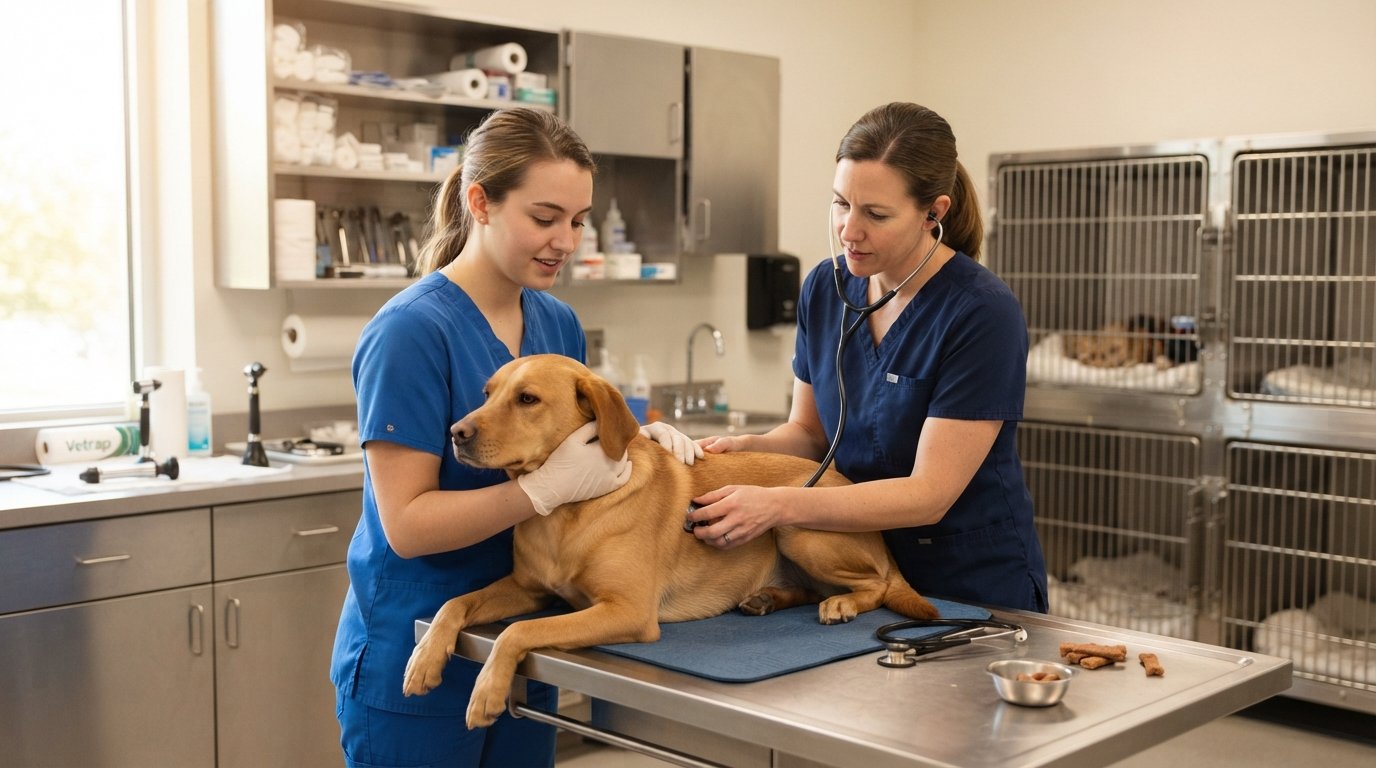
Veterinary Technician Associate's Degree at A-B Tech
Earn your Veterinary/Animal Health Technology/Technician and Veterinary Assistant Associate's degree, usually 2 years In-person at Asheville-Buncombe Technical Community College, and start a hands-on animal care career.
By James Morgan
If you have ever considered turning a love for animals into a stable, hands-on healthcare career, the Veterinary/Animal Health Technology/Technician and Veterinary Assistant Associate's degree, usually 2 years In-person at Asheville-Buncombe Technical Community College, deserves a close look. This program combines rigorous clinical training with real-world animal handling, preparing graduates for credentialing exams and entry-level roles in veterinary practices, shelters, and research settings. Unlike fully online alternatives, the in-person format ensures you develop the manual dexterity and confidence that employers demand. In this guide, we break down the curriculum, admission steps, costs, career outcomes, and how this degree fits into the broader landscape of accredited online and campus-based health programs.
Program Overview and Accreditation
Asheville-Buncombe Technical Community College (A-B Tech) offers the Veterinary/Animal Health Technology/Technician and Veterinary Assistant Associate's degree, usually 2 years In-person at Asheville-Buncombe Technical Community College, as a traditional, campus-based program. The curriculum is designed to meet the standards set by the American Veterinary Medical Association (AVMA) Committee on Veterinary Technician Education and Activities (CVTEA). Graduates are eligible to sit for the Veterinary Technician National Examination (VTNE) and apply for state credentialing. The program awards an Associate of Applied Science (AAS) degree, which is the recognized credential for veterinary technicians in North Carolina and most other states.
Because the training is in-person, students benefit from direct access to the college's veterinary teaching facilities, including surgical suites, radiology equipment, and a pharmacy. The program also maintains partnerships with local clinics and animal hospitals, giving students supervised clinical experience before graduation. This hands-on component is a major differentiator from online-only veterinary assistant courses, which often lack the depth required for technician-level responsibilities.
Accreditation matters for two reasons: it ensures the program meets national educational standards, and it is a prerequisite for taking the VTNE in many states. A-B Tech's program has maintained AVMA accreditation, meaning your degree will be recognized by employers and credentialing bodies across the country. If you are comparing programs, always verify current accreditation status through the AVMA website or the college catalog.
Admission Requirements and Application Process
Admission to the Veterinary/Animal Health Technology/Technician and Veterinary Assistant Associate's degree, usually 2 years In-person at Asheville-Buncombe Technical Community College, is competitive. The college uses a selective admissions process that considers academic performance, prior coursework, and sometimes animal handling experience. Applicants must first be admitted to A-B Tech as a general student, then submit a separate application to the veterinary technology program.
Prerequisite courses typically include college-level English, mathematics, and biology, with a minimum grade point average. Some applicants complete additional courses in chemistry or animal science to strengthen their application. Because the program is in-person and cohort-based, seats are limited, and meeting the minimum requirements does not guarantee admission. Prospective students should work closely with an academic advisor to plan their prerequisite coursework and stay informed about application deadlines.
Here is a typical sequence of steps for applying:
- Apply to A-B Tech and submit official high school and college transcripts.
- Complete required placement tests or submit SAT/ACT scores if applicable.
- Finish prerequisite courses with grades that meet or exceed program minimums.
- Submit the program-specific application by the published deadline, including any required observation hours or references.
- Attend a mandatory information session or interview if requested by the program.
After acceptance, students must also meet health and safety requirements, including vaccinations, tuberculosis screening, and a criminal background check. These are standard for clinical programs and are necessary for participation in off-campus clinical rotations. Keeping these steps organized can reduce stress and ensure you do not miss critical deadlines.
Curriculum and Hands-On Training
The curriculum for the Veterinary/Animal Health Technology/Technician and Veterinary Assistant Associate's degree, usually 2 years In-person at Asheville-Buncombe Technical Community College, blends classroom instruction with laboratory and clinical practice. Courses cover anatomy and physiology, pharmacology, surgical nursing, anesthesia, radiology, dentistry, clinical pathology, and animal behavior. Students also study veterinary office management and client communication, which are essential for working effectively in a practice setting.
In the first year, students typically focus on foundational sciences and basic animal care skills. The second year emphasizes advanced clinical procedures, emergency care, and supervised clinical rotations in partner clinics or the college's teaching facility. Because the program is in-person, students practice venipuncture, catheter placement, and surgical instrument handling on live animals under direct supervision. This level of repetition builds the muscle memory and confidence that online simulations cannot replicate.
Beyond technical skills, the program emphasizes professional ethics, animal welfare, and teamwork. Veterinary technicians must communicate clearly with pet owners, often in stressful situations, and collaborate closely with veterinarians and other staff. Coursework in client education and grief support helps graduates navigate these human-centered aspects of the job. By graduation, students have assembled a portfolio of clinical competencies and are prepared to take the VTNE.
Costs, Financial Aid, and Return on Investment
Tuition for the Veterinary/Animal Health Technology/Technician and Veterinary Assistant Associate's degree, usually 2 years In-person at Asheville-Buncombe Technical Community College, is based on North Carolina community college rates, which are among the most affordable in the country. In-state students pay significantly less than out-of-state residents, and additional costs include textbooks, uniforms, lab fees, and professional dues. Financial aid options include federal grants, student loans, work-study, and scholarships offered by the college foundation or veterinary associations.
Prospective students should create a budget that accounts for both direct educational costs and indirect expenses like transportation to clinical sites and pet care during long lab days. Compared to four-year veterinary degrees, the associate's degree offers a faster path to employment and a lower total cost. Many graduates begin earning within months of graduation, which improves the return on investment. For adult learners balancing work and family, the in-person schedule may require careful planning, but the program's two-year duration keeps the commitment manageable.
If you are exploring financial aid options for health-related programs, you may find our guide on the Bachelor of Health Information Management Degree Online: A Guide helpful for understanding how aid works across different healthcare degrees. That article explains how to compare tuition, fees, and scholarship opportunities across programs, which is useful even if you plan to attend an in-person veterinary technology program.
Career Outcomes and Credentialing
Graduates of the Veterinary/Animal Health Technology/Technician and Veterinary Assistant Associate's degree, usually 2 years In-person at Asheville-Buncombe Technical Community College, pursue roles such as veterinary technician, veterinary assistant, laboratory animal technician, and animal care specialist. Employment settings include private veterinary practices, emergency and specialty hospitals, animal shelters, research facilities, and zoos. The Bureau of Labor Statistics projects steady demand for veterinary technicians, driven by pet ownership trends and advances in veterinary medicine.
Credentialing requirements vary by state, but most require passing the VTNE and completing a background check. In North Carolina, graduates apply for registration through the North Carolina Veterinary Medical Board. Some technicians pursue specialty certifications in areas like emergency and critical care, dentistry, or anesthesia. These advanced credentials can lead to higher pay and leadership roles. The program's faculty often provide guidance on exam preparation and job placement, and many students receive job offers from their clinical rotation sites before graduation.
Salary ranges depend on experience, location, and specialty. Entry-level technicians in North Carolina typically earn an hourly wage that supports a modest lifestyle, with opportunities for overtime and shift differentials in emergency settings. Over time, technicians can move into supervisory roles, sales, education, or practice management. The associate's degree also provides a foundation for those who wish to pursue a bachelor's degree in veterinary technology or a related field later.
Why Choose In-Person Training at A-B Tech
Choosing an in-person program over an online option is a practical decision for veterinary technology. The Veterinary/Animal Health Technology/Technician and Veterinary Assistant Associate's degree, usually 2 years In-person at Asheville-Buncombe Technical Community College, offers access to live animals, surgical equipment, and experienced instructors who can correct technique in real time. This immersive environment builds competence and confidence that employers value. Additionally, the cohort model fosters strong peer relationships and professional networks that last throughout your career.
A-B Tech is located in Asheville, North Carolina, a region known for its veterinary community and outdoor lifestyle. Students can take advantage of local internships and volunteer opportunities with shelters and wildlife organizations. The college also provides tutoring, advising, and career services to support student success. For adult learners, the structured schedule and face-to-face interaction can be more motivating than self-paced online courses.
If you are considering other healthcare or animal science programs, it helps to compare formats and outcomes. Platforms like CollegeDegree.Education connect prospective students with accredited colleges and universities, offering tools to search and compare programs. Such resources can help you evaluate whether an in-person associate's degree or an online bachelor's degree better fits your career goals and schedule.
Comparing Online and In-Person Options
While the Veterinary/Animal Health Technology/Technician and Veterinary Assistant Associate's degree, usually 2 years In-person at Asheville-Buncombe Technical Community College, is campus-based, some prospective students wonder about online alternatives. Fully online veterinary technology programs are rare because clinical skills require hands-on practice. However, online courses in veterinary assisting or animal science can supplement your learning or help you prepare for prerequisite coursework. If flexibility is a priority, you might consider online health information management or healthcare administration degrees as adjacent career paths.
When comparing programs, look at accreditation, pass rates for the VTNE, clinical site availability, and total cost. In-person programs generally offer stronger clinical preparation, while online programs may be more accessible for working adults. Some colleges offer hybrid formats that combine online coursework with periodic on-campus labs. A-B Tech's program is entirely in-person, which is ideal for students who want maximum clinical exposure and are able to attend classes in Asheville.
It is also worth noting that career changers and adult learners often qualify for financial aid and scholarships targeted to healthcare training. Talking with an admissions advisor can clarify options and help you build a realistic plan. Whether you choose an in-person veterinary technology program or an online degree in a related field, the key is to align your education with your long-term career goals and lifestyle.
For anyone ready to work directly with animals in a clinical setting, the Veterinary/Animal Health Technology/Technician and Veterinary Assistant Associate's degree, usually 2 years In-person at Asheville-Buncombe Technical Community College, provides a focused, affordable, and respected pathway. By combining accredited coursework with extensive hands-on training, the program prepares you for credentialing and a rewarding career in veterinary medicine. Take the next step by reviewing the college's admissions requirements and speaking with an advisor about your goals.