
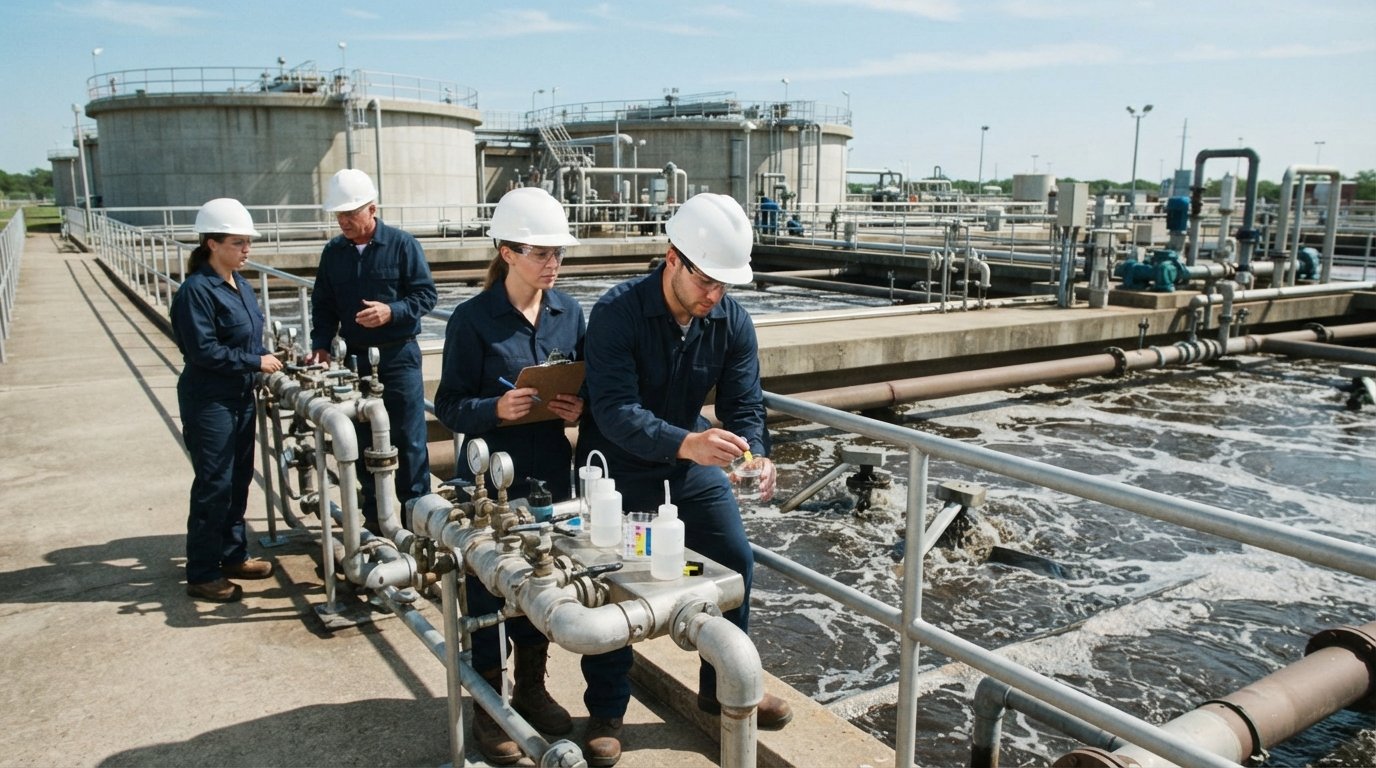
Water Treatment Technician Certificate at Delgado
The Water Quality and Wastewater Treatment Management and Recycling Technology/Technician Certificate at Delgado trains you for essential operator jobs in under a year.

By Oliver Brooks
Clean water does not happen by accident. Every time a faucet turns on or a toilet flushes, a trained professional somewhere is monitoring pumps, testing chlorine levels, and making sure that what flows back into the environment meets strict safety standards. If you are looking for a fast, hands-on path into a stable and essential field, the Water Quality and Wastewater Treatment Management and Recycling Technology/Technician Certificate, 12 weeks to less than 1 year In-person at Delgado Community College deserves a close look. This short-term credential prepares students for entry-level roles in one of the most critical infrastructure sectors in the country, and it can be completed in under a year.
What This Certificate Program Covers
The Water Quality and Wastewater Treatment Management and Recycling Technology/Technician Certificate, 12 weeks to less than 1 year In-person at Delgado Community College is designed as a fast-track credential for people who want to enter the water and wastewater industry quickly. Delgado Community College, located in New Orleans, Louisiana, offers this program through its Technical Division, and the coursework blends classroom instruction with practical, hands-on training. Students learn how to operate and maintain the equipment used in drinking water treatment plants, wastewater treatment facilities, and water recycling systems.
Because the program is delivered in person, students get direct access to labs, simulators, and instructors who have worked in the field. This matters in a discipline where troubleshooting a pump or calibrating a chemical feeder cannot be learned from a textbook alone. The compressed timeline (12 weeks to less than one year, depending on the specific track and course load) makes it attractive for adults who need to upskill or change careers without committing to a two-year or four-year degree.
Core topics typically include water sources and characteristics, coagulation and flocculation, sedimentation, filtration, disinfection, biological nutrient removal, sludge handling, laboratory testing, and regulatory compliance. Students also gain familiarity with the Safe Drinking Water Act and the Clean Water Act, which govern how public systems must operate. Safety practices, recordkeeping, and basic math for treatment calculations are woven throughout the curriculum.
Why Water and Wastewater Careers Are in Demand
The American Water Works Association and the Bureau of Labor Statistics have both flagged a looming wave of retirements in the water sector. Many current operators are nearing retirement age, and replacements are not entering the field fast enough. That gap translates into opportunity for certificate holders who can demonstrate they understand treatment processes and are ready to sit for state licensure exams.
Water treatment and wastewater treatment plant operators earned a median annual wage of around $54,000 in recent BLS data, with experienced operators and supervisors earning significantly more. Public utilities also tend to offer strong benefits, pension plans, and job security because water and wastewater services are essential regardless of economic conditions. The work is local, meaning graduates can often find positions close to home rather than relocating to a handful of major metros.
Another advantage is portability. Treatment technology is similar across states, so the foundational knowledge gained in a certificate program can transfer to different regions, even though licensure requirements vary by state. Many employers also pay for continuing education and exam fees, making it easier to climb the operator certification ladder once you are hired.
Admission Requirements and How to Enroll
Delgado Community College generally requires applicants to have a high school diploma or equivalent for admission to certificate programs. Because this is a technical certificate, there may be additional placement testing in math and English to ensure students are ready for the coursework. Prospective students should contact the college's admissions office or the Technical Division directly for the most current requirements, deadlines, and start dates.
It helps to prepare in advance. Before applying, gather the following items:
- Official high school transcript or GED scores
- Placement test results or prior college transcripts if applicable
- Completed application for admission to Delgado Community College
- Any financial aid documents if you plan to use federal or state aid
Financial aid options may include Pell Grants, Louisiana GO Grant, workforce development funding, and employer tuition assistance programs. Because the program is short, many students pay out of pocket or use small scholarships, but it is still worth completing the FAFSA to see what you qualify for. Some utility companies and municipal governments also sponsor employees to complete this type of certificate, so ask your employer if you are already working in a related job.
What You Will Learn: A Closer Look at the Curriculum
The curriculum for the Water Quality and Wastewater Treatment Management and Recycling Technology/Technician Certificate, 12 weeks to less than 1 year In-person at Delgado Community College is built around the day-to-day realities of operating a treatment facility. Students learn to monitor flow rates, adjust chemical dosages, collect samples, interpret lab results, and respond to alarms and equipment failures. They also study the science behind treatment: how bacteria break down organic matter, how filters remove particles, and how disinfection kills pathogens without creating harmful byproducts.
Hands-on labs are a central part of the experience. Depending on the course sequence, students may work with bench-scale treatment models, practice titration and jar testing, learn to read and draw process flow diagrams, and perform basic maintenance on pumps, valves, and motors. Instructors often bring in real-world scenarios from local utilities, so students graduate with a sense of what a night shift at a treatment plant actually feels like.
Math and chemistry are not avoided; they are applied. Students learn the formulas used to calculate detention time, loading rates, chlorine demand, and solids concentrations. These calculations appear on state certification exams, so practicing them in class is directly relevant to earning a license and getting hired.
Career Outcomes and Licensure Pathways
Graduates of this certificate program typically pursue roles such as water treatment operator, wastewater treatment operator, collection system technician, laboratory assistant, or utility maintenance worker. With experience and additional exams, they can advance to shift supervisor, plant manager, or compliance specialist. Some graduates continue their education, stacking this certificate into an associate degree in environmental technology or a related field.
Licensure is handled at the state level. In Louisiana, the Department of Health and the Department of Environmental Quality oversee operator certification for drinking water and wastewater systems, respectively. Certification levels usually start at Class IV or Class III and move up through Class I as operators gain experience and pass exams. The certificate program helps students build the knowledge base they need to sit for entry-level exams, but actual licensure requires passing the state exam and meeting experience requirements.
Job placement support varies, but Delgado Community College typically offers career services, resume help, and connections to local employers. Utility companies in the New Orleans area and across Louisiana frequently recruit from these programs because they know the training is practical and aligned with state regulations.
How This Certificate Compares to Longer Degrees
One of the biggest advantages of the Water Quality and Wastewater Treatment Management and Recycling Technology/Technician Certificate, 12 weeks to less than 1 year In-person at Delgado Community College is speed. A two-year associate degree in environmental technology provides broader science training and may open doors to laboratory or supervisory roles more quickly, but it also takes longer and costs more. A four-year engineering degree opens design and management paths but is not necessary for most operator jobs.
For adults who need to start earning quickly, the certificate is often the smartest first step. It gets you into the workforce, builds relevant experience, and lets your employer potentially pay for further education later. If you are exploring other short-term credentials in related fields, our guide on Healthcare Management Certificate Online Guide: Career Paths shows how certificate programs can lead to management-track roles in another essential industry.
It is also worth comparing this program to online options. Some water treatment courses are available online, but the in-person format at Delgado offers lab access and face-to-face instruction that online programs cannot fully replicate. For hands-on technical training, in-person is usually the better choice.
Paying for the Program and Understanding ROI
Tuition for technical certificates at Louisiana community colleges is generally affordable, often costing a few thousand dollars for the entire program. Compare that to the starting salaries in the field and the return on investment can be measured in months rather than years. Many students graduate with little or no debt, especially if they qualify for Pell Grants or workforce grants.
To estimate your ROI, consider the following:
- Total tuition and fees for the certificate
- Books, supplies, and any exam fees
- Lost wages if you reduce work hours to attend class
- Expected starting salary in your area
- Benefits such as health insurance and retirement contributions
For many students, the numbers work out favorably within the first year of employment. Utilities also tend to have predictable raises and promotion schedules, so the long-term earnings trajectory is stable. If you are comparing this program to other credentials, resources like CollegeDegrees.School can help you understand how certificate and degree pathways differ in cost and career outcomes.
Is This Program Right for You?
This certificate is a strong fit for people who enjoy hands-on work, do not mind shift schedules, and want a job that matters to their community. It is also a good option for veterans, displaced workers, and anyone who wants to enter a technical field without spending years in school. If you are comfortable with basic math and science, willing to work outdoors or in industrial settings, and looking for job security, the water and wastewater field offers all of that.
On the other hand, if you prefer a desk job, dislike rotating shifts, or want to avoid chemistry and math, this may not be the best path. It is also not a substitute for an engineering degree if your goal is to design treatment systems rather than operate them. Being honest about your interests and work style will help you decide whether to enroll.
Before committing, visit the campus if possible, talk to an advisor, and ask about job placement rates and employer partnerships. Those conversations will give you a clearer picture of what to expect after graduation.
The Water Quality and Wastewater Treatment Management and Recycling Technology/Technician Certificate, 12 weeks to less than 1 year In-person at Delgado Community College is a practical, affordable, and fast route into a career that keeps communities healthy. If you are ready to train for a role that will always be needed, this program is worth exploring.