The demand for skilled accountants remains robust, but the traditional path to entering the profession has been transformed by digital education. Whether you are aiming for a full bachelor’s degree, a specialized certification, or just a few courses to enhance your skills, online accounting courses and degree programs offer unprecedented flexibility and access. This guide is designed to navigate the expansive landscape of digital accounting education, helping you identify the right path, understand accreditation, evaluate costs, and align your studies with your career goals. The journey to becoming a CPA, a corporate accountant, or a financial analyst can now begin from anywhere, fitting around your existing commitments.
Understanding Your Educational Pathways in Accounting
Online accounting education is not a one-size-fits-all endeavor. The right choice depends entirely on your starting point, your professional objectives, and the time you can commit. For some, the goal is a comprehensive credential that fulfills the educational requirements for the CPA exam. For others, it may be skill-building in a specific area like forensic accounting or tax preparation. The first step is to conduct an honest self-assessment. Are you a high school graduate seeking a first career? A professional in another field looking to pivot? Or an experienced accountant needing continuing education credits? Your answer will determine whether you should pursue a full degree, a post-baccalaureate certificate, or individual courses.
Once you have clarity on your goal, you can map it to the appropriate academic offering. A foundational associate degree in accounting, often completed in two years, introduces core principles and can qualify you for bookkeeping or accounting clerk roles. The bachelor’s degree is the standard entry-point for most professional accounting positions and is required to sit for the CPA exam in virtually all jurisdictions. For those seeking leadership roles or specialization, a Master of Accountancy (MAcc) or an MBA with a concentration in accounting provides advanced knowledge. Crucially, many institutions offer seamless pathways, allowing you to stack credentials, for example, rolling an associate’s degree into a bachelor’s program.
The Critical Importance of Accreditation
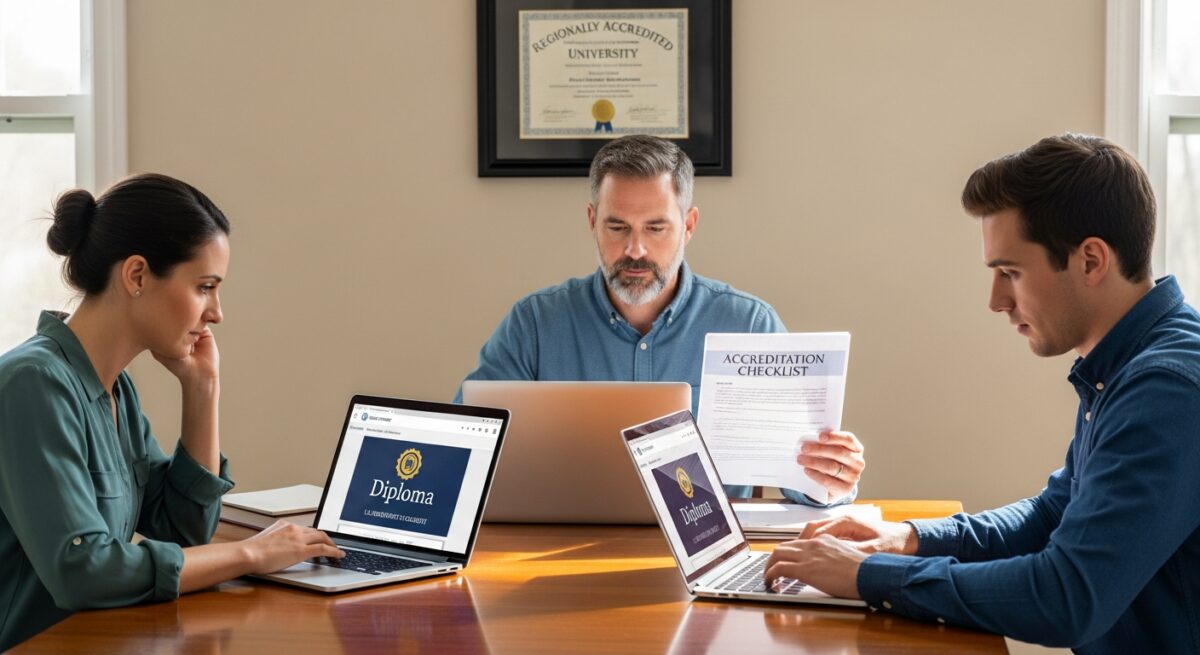
In the world of online education, accreditation is the non-negotiable hallmark of quality and legitimacy. It is the process by which an independent agency evaluates a school or program against established standards of educational excellence. For accounting students, accreditation serves two vital functions: it ensures your education meets professional standards, and it is a prerequisite for certification and licensure. Employers and state boards of accountancy will scrutinize the accreditation status of your alma mater. Attending a non-accredited institution can render your degree worthless for professional advancement.
There are two primary types of accreditation to understand: institutional and programmatic. Institutional accreditation applies to the entire university and is granted by regional or national agencies recognized by the U.S. Department of Education. Regional accreditation is generally considered the most prestigious and widely accepted. For accounting specifically, programmatic accreditation from the Association to Advance Collegiate Schools of Business (AACSB) is the gold standard. An AACSB-accredited accounting program signals a rigorous curriculum, qualified faculty, and a commitment to continuous improvement. When researching an accounting degree online, verifying both institutional and AACSB accreditation should be your top priority. For a broad search of vetted options, our resource on the best online bachelor’s degree programs follows similar accreditation principles critical for any field.
Evaluating Program Structure and Student Support
The best online accounting courses are designed with the adult learner in mind, offering structure without sacrificing flexibility. Two primary formats dominate: asynchronous and synchronous. Asynchronous courses allow you to access lectures, readings, and assignments on your own schedule, ideal for those with irregular work or family commitments. Synchronous courses require you to be online at specific times for live virtual classes, fostering real-time interaction. Many programs use a hybrid model. Beyond the delivery mode, examine the curriculum’s relevance. Does it cover current accounting software (like QuickBooks, SAP, or Oracle)? Are there courses in data analytics for accountants, a rapidly growing skillset? A robust program will integrate technology and soft skills like communication and ethics.
Equally important is the level of student support provided. A quality online program should offer dedicated academic advising for distance learners, career services that include virtual networking and resume assistance, and robust technical support. Look for opportunities for interaction, such as online study groups, discussion forums moderated by instructors, and virtual office hours. The learning management system (LMS), such as Canvas or Blackboard, should be intuitive and reliable. Before enrolling, consider reaching out to the admissions department with specific questions about support services to gauge their responsiveness and commitment to online students.
Balancing Cost, Financial Aid, and Return on Investment
The cost of an online accounting degree can vary dramatically, from affordable public university programs to premium private institution offerings. Tuition is often presented as a cost per credit hour. To calculate total cost, multiply the credit-hour cost by the total number of credits required for the degree, and add any mandatory fees. However, the sticker price is not the final word. Many students significantly reduce their out-of-pocket expense through financial aid. The first step for any student is to complete the Free Application for Federal Student Aid (FAFSA) to determine eligibility for federal grants, loans, and work-study programs.
Beyond federal aid, actively seek out scholarships from professional accounting organizations (like the AICPA), state societies of CPAs, and the universities themselves. Many employers also offer tuition reimbursement programs as a benefit. When evaluating cost, always factor in the return on investment (ROI). An accounting degree online from an accredited institution typically offers a strong ROI due to the profession’s solid median salaries and low unemployment rates. Compare potential post-graduation salaries in your desired role and location against the total cost of the program. An investment in a slightly more expensive, highly-ranked program may pay off through better recruitment opportunities and higher starting salaries. Exploring a wide range of accredited online degrees can help you compare costs and structures across disciplines to make an informed financial decision.
Career Outcomes and Specialization Options
An accounting education opens doors to diverse career paths beyond the traditional public accounting firm. The core curriculum prepares you for roles in auditing, tax, and management accounting. However, the field is rich with specializations that can differentiate you in the job market. Many online finance courses online allow you to delve into niches like forensic accounting (investigating financial crimes), governmental accounting, or international accounting. Earning a certificate in a specialized area alongside your degree can make you particularly attractive to employers.
The ultimate goal for many is becoming a Certified Public Accountant (CPA). It is crucial to understand that an online accounting degree is the first step. CPA licensure requires meeting specific educational credit requirements (typically 150 semester hours, which often means completing a master’s degree), passing the uniform CPA exam, and fulfilling work experience under a licensed CPA. When choosing your program, ensure its curriculum aligns with your state’s specific CPA education requirements. Other valuable certifications include Certified Management Accountant (CMA), Certified Internal Auditor (CIA), and Certified Fraud Examiner (CFE), each with its own exam and experience prerequisites that can be pursued during or after your degree.
Frequently Asked Questions
Are online accounting degrees respected by employers?
Yes, degrees from regionally and programmatically accredited online institutions are widely respected. Employers primarily care about accreditation and skills. The stigma once associated with online degrees has largely faded, especially when the program is from a well-known brick-and-mortar university.
Can I become a CPA with an online accounting degree?
Absolutely. As long as the program is accredited and meets your state board of accountancy’s specific educational requirements (including accounting and business credit hours), an online degree is fully valid for CPA exam eligibility and licensure.
How long does it take to complete an online bachelor’s in accounting?
For full-time students, it typically takes four years. However, many online programs are designed for accelerated completion, often through year-round courses. Students with transfer credits or an associate degree may finish a bachelor’s in two years or less.
What technology do I need for online accounting courses?
You will need a reliable computer (Windows or Mac), high-speed internet, a webcam, and a microphone. Specific software requirements will vary; some programs may require access to professional accounting software, which is often provided through a virtual lab or student license.
How do I verify a school’s accreditation?
Do not rely solely on the school’s website. Verify institutional accreditation through the U.S. Department of Education’s Database of Accredited Postsecondary Institutions and Programs. For AACSB accounting accreditation, check the AACSB International’s business school database directly.
Choosing the right online accounting program is a significant decision that lays the foundation for a stable and rewarding career. By prioritizing accredited institutions, carefully evaluating program structure and support, and strategically planning your finances and career trajectory, you can invest in an education that pays dividends for a lifetime. The flexibility of digital learning means you can build your future in accounting without putting your current life on hold.