
Bergen Community College Manufacturing Engineering Associate's Degree
A Manufacturing Engineering Associate's degree, usually 2 years In-person at Bergen Community College, offers hands-on training for entry-level technician roles.

By Wendy Young
Manufacturing is back in the national spotlight, and the technicians who can program a CNC machine, read a tolerance stack, and troubleshoot a production line are in short supply. If you want a fast, hands-on route into that world without committing four years to a bachelor's degree, a Manufacturing Engineering Associate's degree, usually 2 years In-person at Bergen Community College, is one of the most direct paths available in northern New Jersey. The program trades lecture-heavy theory for shop-floor practice, and it is built for students who learn by doing.
Bergen Community College, located in Paramus, sits in the middle of one of the densest manufacturing and logistics corridors in the country. That geography matters. Local employers need entry-level engineering technicians, quality inspectors, and process support staff, and a two-year degree signals that you have already spent time with the machines and software those employers use. This guide breaks down what the program covers, who it fits, what it costs, and how to decide whether it is worth your time.
What a Manufacturing Engineering Associate's Degree Covers
Associate-level manufacturing engineering technology programs blend the fundamentals of engineering with practical production skills. You will not be designing aircraft engines from scratch, but you will learn why a part fails inspection, how to set up a machining operation, and how to document a process so the next shift can repeat it. At Bergen, coursework typically moves through three layers: foundational math and science, core manufacturing courses, and general education requirements that transfer toward a four-year degree.
The math and science foundation usually includes algebra, trigonometry, and introductory physics or chemistry, depending on placement. These are not filler courses. Tolerance analysis, speeds and feeds, and material behavior all rest on them, and students who rush through the math tend to struggle later in the machine lab. Core manufacturing courses typically cover blueprint reading and geometric dimensioning and tolerancing, computer-aided design using tools such as AutoCAD or SolidWorks, CNC programming and setup, materials and processes, quality control and metrology, and lean manufacturing principles.
- Blueprint reading and GD&T: interpreting engineering drawings and tolerance symbols used on the shop floor.
- CAD and CAM: creating and modifying models, then generating toolpaths for machining.
- CNC operations: programming, setting up, and running mills and lathes.
- Quality and metrology: using calipers, micrometers, and coordinate measuring equipment.
- Lean and process improvement: reducing waste, standardizing work, and supporting continuous improvement.
General education requirements, including English composition, technical communication, and social science electives, round out the degree. They may feel disconnected from the shop, but employers consistently rank communication and documentation skills among the top gaps in new technicians. Being able to write a clear inspection report or explain a process change to a supervisor is part of the job.
The in-person format is a genuine feature, not a limitation. Manufacturing is a tactile field, and running a machine, feeling a bad cut, or aligning a fixture teaches lessons that video lectures cannot replicate. Students who compare this program to fully online options should weigh that laboratory access carefully.
Why the In-Person Format at Bergen Matters
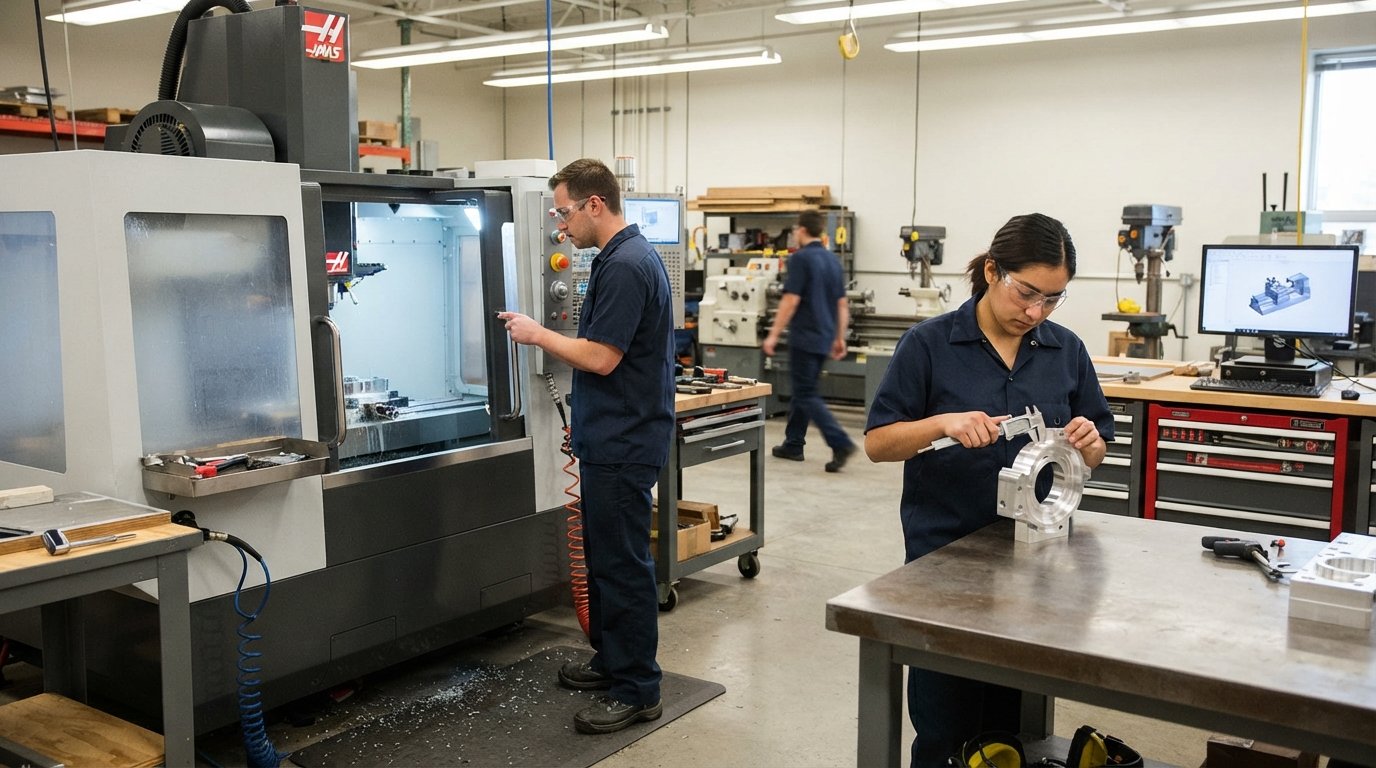
Bergen Community College's manufacturing labs give students access to the same categories of equipment they will encounter on the job: manual mills and lathes, CNC machines, measurement instruments, and CAD workstations. Working alongside an instructor who can stop you mid-operation and correct your setup is how safe habits form. Online simulations are improving, but they cannot teach you to hear a tool chatter or smell coolant burning.
In-person attendance also builds the professional habits employers expect: showing up on time, wearing the right protective equipment, keeping a clean work area, and communicating with classmates on a shared project. Instructors who have worked in industry often bring real production stories into the classroom, and those stories are where a lot of the practical judgment gets passed down. For adult learners balancing jobs and family, the tradeoff is real, but the schedule at a community college is often more flexible than a four-year residential program.
Location is another practical advantage. Paramus is accessible from much of Bergen, Passaic, and Rockland County, and the surrounding region includes machine shops, medical device manufacturers, food processing facilities, and distribution operations. Many students work part-time or full-time in these settings while enrolled, which turns classroom lessons into immediate on-the-job application.
Admissions, Cost, and Transfer Pathways
Admission to a community college associate's program is generally straightforward compared with four-year universities. Applicants typically need a high school diploma or equivalent, and placement testing or prior coursework determines where they start in math and English. Students who place into developmental courses should factor that extra time into their plan; arriving ready for college-level algebra can save a full semester.
Cost is one of the strongest arguments for the associate's route. Community college tuition is a fraction of what public and private four-year schools charge, and New Jersey residents pay lower rates than out-of-state students. Financial aid, including federal grants, state programs, and institutional scholarships, can reduce the bill further. Students should also ask about employer tuition assistance, since many manufacturing companies reimburse part of the cost for employees pursuing relevant credentials. Resources like Scholarship.Education can help you find scholarships and financial aid opportunities beyond the standard federal forms.
Many students enter the workforce after two years, but the degree also transfers. Bergen has articulation agreements that allow graduates to continue into bachelor's programs in engineering technology, industrial technology, or operations management at four-year institutions. If you are weighing a business-focused path instead, our guide to the Berkeley City College Business Administration Associate's Degree shows how another two-year program structures its transfer options. The key is to confirm with an advisor early which courses transfer, because not every technical credit does.
Careers and Salary Outlook After Graduation
Graduates typically enter the workforce as engineering technicians, manufacturing technicians, CNC programmers, quality assurance technicians, or production support specialists. In northern New Jersey, these roles appear across medical device manufacturing, pharmaceutical packaging, aerospace suppliers, food production, and logistics operations. The work is often hands-on and team-based, with clear paths toward lead technician, process engineer support, or supervisor roles after a few years.
Salaries vary by employer, shift, and experience, but entry-level manufacturing technician roles in the region generally pay enough to make the two-year investment recoverable within a few years, especially for students who work while enrolled or receive employer tuition support. Overtime and shift differentials can raise total compensation meaningfully. Students should research current postings in their area rather than relying on national averages, since local demand for CNC and quality skills is strong.
Further education pays off too. A bachelor's degree in engineering technology or industrial engineering can open doors to process engineering and management roles, and some employers pay for that progression. The associate's degree is a credential that gets you hired and productive quickly, not a dead end.
Is This Program Right for You?
The strongest candidates for a Manufacturing Engineering Associate's degree, usually 2 years In-person at Bergen Community College, share a few traits. They like working with their hands, they are comfortable with math once they practice it, and they want a credential that leads to employment without a four-year commitment. Career changers from automotive, construction, or military backgrounds often do well because they already understand tools, safety, and teamwork.
Before enrolling, visit the campus, tour the labs, and talk to an advisor about placement testing and transfer agreements. Ask current instructors which local employers hire graduates and what software and equipment the labs use. If possible, speak with a student near graduation about the workload. A short campus visit answers more questions than any brochure.
Manufacturing in the United States is not a declining field; it is a changing one, and the change favors people who can operate, program, and improve automated systems. A two-year, hands-on degree from a community college with strong local industry ties is a practical way to enter that field without taking on heavy debt. For students in the Paramus area who want to build things and get paid to do it, this program deserves a serious look.